A security incident can topple an organization’s reputation and revenue in a short amount of time. As billionaire Warren Buffet once said, “it takes 20 years to develop a reputation and five minutes to ruin it.” Keeping that in mind, it’s ideal to have an incident response plan in place before a security breach occurs.
An incident response plan is a set of instructions intended to facilitate an organization in detecting, responding to and recovering from network security incidents such as cyber crime, data loss and service disruptions. Having a plan in place contributes to the development of cybersecurity as well as overall organizational resilience.
Since most small and medium-sized businesses (SMBs) have limited resources and funds, incident response is usually given less attention. However, failing to respond swiftly and effectively when a cyber attack occurs can cost far more than putting an incident response plan in place.
Essential Elements of an Incident Response Plan
Every incident response plan should include the following five key elements in order to successfully address the wide range of security issues that an organization can face:
1. Incident Identification and Rapid Response
It’s critical to evaluate the threat effectively and decide whether to implement the incident response plan. This requires two prerequisites:
- An authorized person to initiate the plan
- An online/offline place for the incident response team to meet and discuss
The sooner the incident is detected and addressed, the less severe the impact.
2. Resources
In case of a cyber event, an incident response team will usually have emergency kits on hand and have the following resources to help navigate through the event:
- Tools to take all machines offline after forensic analysis
- Solutions to regulate access to the organization’s IT environment and keep hackers out of the network
- Measures to employ standby machines to ensure operational continuity
3. Roles and Responsibilities
An incident could occur in the middle of the night or at an unexpected time. That’s why it’s critical to establish the roles and responsibilities of your incident response team members. They could be called in at any time. You must also have a reserve team in case any of the primary contacts are unavailable.
In the event of a cyber incident, time is critical and everyone must know what to do.
4. Detection and Analysis
This is, without a doubt, one of the most crucial elements of an incident response plan. It emphasizes documenting everything, from how an incident is detected to how to report, analyze and contain the threat. The aim is to create a playbook that includes approaches for detecting and analyzing a wide range of risks.
5. Containment, Eradication and Recovery
- Containment specifies the methods for restricting the incident’s scope. A ransomware attack, for example, must be tackled very differently compared to an insider threat.
- Eradication is all about techniques to eliminate a threat from all affected systems.
- Because incidents cannot always be prevented, recovery efforts concentrate on reducing potential harm and resuming operations as quickly as possible.
Considerations for an Incident Response Plan
An incident response plan must address any concerns that arise from an evolving threat landscape. Before you start crafting your plan, there are several considerations to be made, including:
- Building an incident response plan should not be a one-off exercise. It should be reviewed on a regular basis to ensure that it considers the most recent technical and environmental changes that may influence your organization.
- Your incident response plan and the team working on it must be supported and guided by top management.
- It’s critical to document the contact information of key personnel for emergency communication.
- Every person in the incident response team must maintain accountability.
- Deploy the appropriate tools and procedures to improve the effectiveness of the incident response.
- Your security, backup and compliance postures must all be given the same attention.
We live in an era where only resilient organizations can navigate through all the complexities created by technological advancements and other unexpected external influences. That’s why having an incident response plan is essential.
An Effective Incident Response Plan Starts Before an Incident Occurs
When a cybersecurity incident occurs, confusion and uncertainty can significantly increase the impact on the organization. A well-developed incident response plan helps eliminate guesswork by defining responsibilities, communication procedures, escalation paths, recovery priorities, and decision-making processes before they are needed.
The most effective plans are not created simply to satisfy compliance requirements. They are designed to help organizations respond quickly, contain threats, protect critical systems, minimize operational disruption, and recover efficiently when unexpected events occur.
An incident response plan should be viewed as a living document that evolves alongside the organization, technology environment, and threat landscape. Regular reviews, testing, and updates help ensure the plan remains effective when it matters most.
The best time to prepare for a cybersecurity incident is long before one occurs.
Would Your Team Know What to Do During a Cyber Incident?
Many organizations invest in cybersecurity tools but never fully document how employees, leadership, vendors, and technology teams should respond when an incident occurs. If you’re unsure whether your incident response plan is complete, current, and actionable, schedule a free consultation with ITNS Consulting.
We’ll help evaluate your current preparedness, identify gaps, and develop a practical incident response strategy that supports business continuity, cybersecurity resilience, and operational recovery.
Does Your Organization Have a Complete Incident Response Plan?
A documented response plan can significantly reduce confusion, downtime, and business disruption during a cybersecurity event.
Download our Incident Response Quick Start Plan Template to establish clear roles, responsibilities, communication procedures, escalation paths, and recovery actions that help your organization respond effectively when an incident occurs.
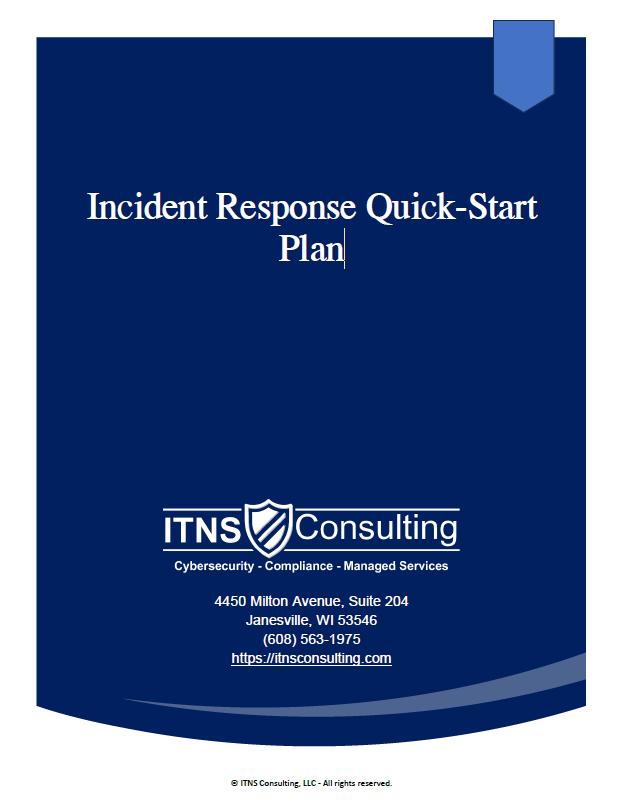
🚨 Incident Response Quick Start Plan — Free Download
React Fast. Minimize Damage. Restore Operations With Confidence.
This plan breaks incident response into clear, actionable steps that help you contain threats, protect critical systems and data, preserve evidence, and communicate confidently.
It also guides secure system recovery and documentation of findings to reduce risk and prevent similar incidents from happening again.
Perfect for:
✔️ Small and mid-size businesses without a formal IR plan
✔️ Teams evaluating their current provider’s response capabilities
✔️ Organizations preparing for cyber‑insurance renewal
✔️ Leaders wanting basic readiness before adopting full IR playbooks
✔️ Anyone who wants to reduce panic and confusion during an incident