

Cybersecurity compliance for law firms is no longer just a technology issue; it is an ethical, operational, and client trust obligation. Attorneys and legal staff handle privileged communications, confidential case files, business records, financial details, personally identifiable information, medical records, intellectual property, litigation strategy, and sensitive discovery materials every day. That makes law firms attractive targets for cyber criminals and places them under growing pressure to prove that reasonable safeguards are in place to protect client information.
For many small and mid-sized law firms, the challenge is not whether cybersecurity matters. Most firms understand that ransomware, phishing, business email compromise, unauthorized access, and data loss can create serious consequences. The real challenge is knowing where to begin, how to prioritize limited resources, and how to document the firm’s efforts in a way that supports ethical duties, client expectations, cyber insurance requirements, and long-term operational resilience.
Cybersecurity Compliance for Law Firms: Why It Matters
Law firms operate on trust, confidentiality, and availability. Clients expect their attorneys to protect sensitive information with the same care used to manage legal strategy. A cybersecurity incident can expose confidential client data, disrupt court deadlines, delay transactions, damage reputation, create malpractice concerns, trigger breach notification obligations, and weaken the firm’s ability to serve clients.
Cybersecurity compliance matters because it gives law firms a structured way to manage technology risk. Instead of relying on informal practices or reactive IT support, firms can establish documented safeguards, assign responsibility, train staff, monitor systems, test recovery capabilities, review vendors, and demonstrate that reasonable steps are being taken to preserve confidentiality and continuity.
The Compliance and Ethics Pressure Is Increasing
Law firms may need to consider ethical obligations, client contractual requirements, cyber insurance standards, state privacy laws, breach notification rules, court expectations, and industry-specific requirements connected to the type of data they handle. Firms that work with healthcare clients, financial institutions, government contractors, or regulated businesses may also encounter obligations tied to HIPAA, GLBA, FTC Safeguards Rule expectations, NIST-based controls, CMMC-related requirements, or other security frameworks.
Even when a law firm is not directly regulated by a specific cybersecurity framework, the expectation is clear: attorneys must make reasonable efforts to prevent unauthorized access to client information. Clients are also becoming more sophisticated. Corporate clients, insurance carriers, and referral partners increasingly ask about multi-factor authentication, encryption, backups, endpoint protection, security awareness training, incident response, and vendor oversight before trusting a firm with sensitive matters.
What a Practical Cybersecurity Compliance Program Should Include
A practical cybersecurity compliance program for law firms should be written, repeatable, and aligned with how the firm actually works. It should not be a binder of policies no one follows. It should support day-to-day legal operations while reducing the risk of data exposure, system downtime, and preventable security incidents.
1. Written Information Security Program
A Written Information Security Program, often called a WISP, documents how the firm protects confidential and sensitive information. It should identify the types of information the firm handles, where that information is stored, who can access it, what safeguards are in place, how incidents are reported, and how the program is reviewed over time.
For example, a law firm may document how client intake forms are secured, how case files are stored, how access to practice management software is controlled, how privileged communications are protected, how vendors are reviewed, and how former employees are removed from systems. This written program becomes the foundation for internal accountability, client questionnaires, insurance reviews, audits, and ethics-related risk management.
2. Risk Assessment and Gap Analysis
Law firms should periodically assess their cybersecurity risks across people, processes, technology, and vendors. This includes reviewing email security, remote access, cloud applications, document management systems, practice management platforms, endpoint protection, backup practices, password policies, mobile devices, and employee security habits.
A practical risk assessment may uncover issues such as shared passwords, inactive former employee accounts, unencrypted laptops, unmanaged personal devices, unsupported software, weak remote access controls, inconsistent backup testing, or confidential documents stored in unapproved locations. Once identified, these gaps should be prioritized based on risk, business impact, and ease of remediation.
3. Multi-Factor Authentication and Access Control
Account takeover is a serious risk for law firms because email, cloud storage, remote access, and legal software often contain sensitive client information. Multi-factor authentication should be required for email, Microsoft 365, document storage, practice management systems, remote access tools, password managers, and any system containing confidential data.
Access control should also follow the principle of least privilege. Attorneys, paralegals, administrative staff, and external contractors should only have access to the matters, systems, and records required for their role. When employees change roles or leave the firm, access should be modified or removed promptly. These basic steps can significantly reduce the damage caused by a compromised account.
4. Email Security and Phishing Defense
Email is one of the most common entry points for cyberattacks against law firms. Attorneys and staff exchange pleadings, contracts, settlement details, wire instructions, client records, billing information, discovery materials, and confidential communications through email. Attackers use phishing, spoofing, malicious attachments, fake file-sharing notifications, and fraudulent payment instructions to exploit that trust.
Effective protection should include advanced spam filtering, malicious link protection, attachment scanning, domain authentication, user training, and written procedures for verifying unusual requests. For example, if a client or opposing party emails updated wire instructions, the firm should verify the request using a known, trusted phone number instead of relying on the email thread alone.
5. Security Awareness Training
Technology controls are important, but employees remain one of the most targeted parts of any law firm. Security awareness training should teach attorneys and staff how to recognize phishing emails, social engineering attempts, malicious attachments, fake login pages, fraudulent payment requests, unsafe public Wi-Fi use, and risky data handling practices.
Training should be practical and relevant to legal workflows. A litigation attorney may need guidance on secure discovery exchanges, while an administrative assistant may need to recognize fake vendor invoices or fraudulent payment requests. Short, recurring training sessions and phishing simulations are often more effective than a single annual presentation.
6. Data Backup and Business Continuity
Law firms depend on reliable access to calendars, court deadlines, case files, email, billing records, phone systems, and document repositories. Ransomware, accidental deletion, hardware failure, cloud outages, vendor disruptions, and natural disasters can interrupt operations at the worst possible time. Backups should be monitored, protected from tampering, and tested regularly.
A business continuity plan should explain how the firm will communicate with clients, access critical case information, meet deadlines, restore systems, continue billing, and document decisions during a disruption. For law firms, downtime is not just inconvenient. It can affect client service, court obligations, revenue, and professional reputation.
7. Vendor and Third-Party Risk Management
Law firms rely on outside providers for practice management software, e-discovery platforms, document storage, legal research tools, payment processing, transcription services, cloud hosting, cybersecurity, accounting, and IT support. Each vendor may have access to confidential information or critical systems. Firms should understand what data vendors can access, how that data is protected, and what happens if the vendor experiences a breach or outage.
A basic vendor review process should include security questionnaires, contract review, access documentation, data handling expectations, incident notification requirements, proof of insurance where appropriate, and periodic reassessment. Vendor oversight does not need to be overly complicated, but it should be consistent, documented, and tied to the sensitivity of the information involved.
Common Mistakes Law Firms Make
One common mistake is assuming that small firms are too small to be targeted. Cybercriminals often view smaller law firms as attractive because they hold valuable information but may lack mature security programs, formal policies, or dedicated internal IT resources.
Another mistake is relying on consumer-grade tools for business-critical work. Personal email accounts, unmanaged file-sharing tools, weak passwords, unsupported computers, and informal backup methods may seem convenient, but they increase the risk of exposure and make it harder to prove that reasonable safeguards were in place.
A third mistake is failing to document cybersecurity decisions. If a firm enables multi-factor authentication, performs a risk assessment, updates backups, trains employees, reviews vendors, or creates an incident response plan, that work should be recorded. Documentation helps demonstrate that cybersecurity is being actively managed rather than informally assumed.
How ITNS Consulting Helps Law Firms
ITNS Consulting helps law firms move from uncertainty to confidence by combining Managed IT, cybersecurity, compliance support, and strategic guidance into one governance-first program. Rather than relying on reactive troubleshooting or generic security tools, firms receive a structured approach designed to protect client confidentiality, strengthen operational resilience, support ethical technology responsibilities, and produce predictable outcomes through a flat-fee service model.
Our approach includes risk and vulnerability assessments, cybersecurity policy and procedure support, managed endpoint protection, Microsoft 365 security hardening, secure backup and disaster recovery planning, security awareness training, vendor risk assistance, vCIO/vCISO guidance, and audit-ready documentation. These services are aligned with recognized frameworks such as NIST CSF 2.0 and CIS Controls v8, supported by over 40 layers of protection, 24/7/365 monitoring, daily-tested backups with immutable storage, and practical documentation that helps law firms demonstrate reasonable safeguards. The goal is not just to keep computers running. The goal is to create a repeatable, measurable security program that supports the way your firm serves clients.
Cybersecurity Compliance Is a Client Trust Advantage
Law firms often view cybersecurity compliance as a burden, but it can also become a client trust advantage. A firm that can clearly explain how it protects confidential information, trains employees, manages vendors, responds to incidents, and maintains business continuity sends a powerful message: client confidentiality is being protected by design.
Clients may not understand every technical safeguard, but they do understand professionalism and responsibility. When a law firm can speak confidently about cybersecurity, privacy, and resilience, it reinforces the firm’s commitment to protecting the client relationship from the conference room to the courtroom.
Protecting Client Confidentiality Starts Before a Security Incident
Cybersecurity compliance for law firms is not about responding after a breach, ethics complaint, client questionnaire, or insurance renewal exposes weaknesses. It is about building a practice that can consistently protect confidential information, maintain operational continuity, and meet the expectations of clients, regulators, and professional responsibility requirements.
Law firms that take a proactive approach to cybersecurity are better positioned to reduce risk, document their efforts, respond effectively to evolving threats, and preserve the trust that forms the foundation of every client relationship.
Protecting client confidentiality is no longer solely a legal obligation. It is a business necessity and a critical component of modern law firm management. The firms that prepare today are far better equipped to handle tomorrow’s challenges.
Is Your Law Firm’s Cybersecurity Program Ready for Today’s Expectations?
Many law firms have implemented security tools but remain uncertain whether their cybersecurity program is fully documented, consistently managed, and aligned with evolving client, insurance, and regulatory expectations. If you’re unsure where gaps may exist, schedule a free consultation with ITNS Consulting. We’ll help you evaluate your current cybersecurity posture, identify areas for improvement, and develop a practical roadmap for protecting client confidentiality.
How Well Is Your Firm Protecting Client Confidentiality?
Cybersecurity and confidentiality obligations continue to evolve, and many firms discover gaps only after a client questionnaire, insurance application, or security incident forces a closer review.
Download our Law Firm Cybersecurity & Confidentiality Checklist to evaluate your firm’s cybersecurity practices, identify potential weaknesses, and strengthen your ability to protect sensitive client information.
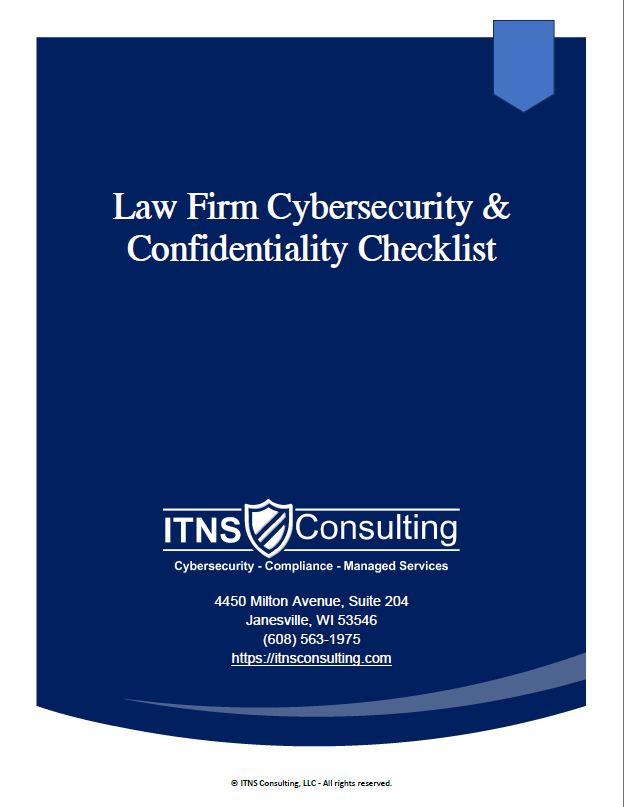
⚖️ Law Firm Cybersecurity & Confidentiality Checklist — Free Download
Protect Client Data. Strengthen Compliance. Reduce Legal Risk.
Perfect for:
✔️ Solo attorneys and small to mid‑sized firms
✔️ Firms undergoing cyber insurance renewal
✔️ Firms with remote or hybrid staff
✔️ Practices handling sensitive or regulated data
✔️ Administrators planning technology improvements