

IT downtime for law firms is more than a technical inconvenience. Lost billable time, delayed client communication, missed internal deadlines, frustrated staff, and added risk to client confidentiality are also consequences for IT downtime. This can also damage the firm’s reputation. When email stops working, a case management system becomes unavailable, or files cannot be accessed, the issue quickly moves beyond “the computers are down.” The same is true when a workstation fails before a filing deadline. It becomes a business problem that affects attorneys, paralegals, administrative staff, and clients. It also affects the firm’s ability to operate securely and confidently.
Most firms understand downtime is expensive. Many still underestimate its full impact because they focus only on the obvious problem: the time someone spends waiting for support. In reality, IT downtime for law firms affects much more than one user or one device. It interrupts billable work, slows document production, delays client responses, and creates compliance concerns. It also forces attorneys and staff to work around systems that should be supporting them. If your firm has ever said, “We cannot keep losing time to IT problems,” this article is for you.
Why IT Downtime for Law Firms Is Different
In a typical office, downtime may mean employees cannot access files or send email for a while. Within a law firm, the impact can be much more serious. Technology supports confidential client communications, time-sensitive legal work, and professional responsibilities. A partner may be preparing for court. An associate may be finalizing a brief. Paralegals may be coordinating discovery. Legal assistants may be sending time-sensitive documents to a client, opposing counsel, or the court. When technology fails during those moments, the disruption touches the core of the firm’s work.
Law firms rely on email, document management systems, practice management platforms, billing tools, phones, scanners, secure remote access, Microsoft 365, cloud storage, endpoint devices, and backup systems. When one of those systems becomes unreliable, the firm’s workflow starts to break down. Attorneys cannot review documents. Staff cannot find the latest version of a file. Calls go unanswered. Calendar reminders fail. Billing entries are delayed. The firm may still be “open,” but the work is not moving the way it should.
This is why downtime should not be measured only in minutes. It should be measured in lost productivity, lost revenue, client frustration, staff stress, operational risk, confidentiality exposure, and the time it takes to recover. For legal professionals, every interruption has a ripple effect.
The Obvious Cost of IT Downtime: Lost Billable Time
The most visible cost of IT downtime is billable time. If an attorney bills at a professional hourly rate and cannot work because a system is unavailable, the financial impact is immediate. Multiply that by several attorneys, paralegals, and support staff, and even a short outage can become expensive quickly.
For example, three attorneys and two staff members may lose access to email, files, or a case management system for two hours. In that case, the firm is not losing only two hours of technology access. It may be losing ten hours of productive work. Some of that time may be recovered later. Often, though, recovery comes with a cost: late evenings, rushed filings, delayed client responses, or rework caused by incomplete information.
This is where many firms underestimate the real financial impact. Downtime is not just the length of the outage. It includes the time spent identifying the issue, contacting support, waiting for a response, testing workarounds, communicating internally, rebuilding momentum, and catching up afterward. Legal work requires focus, accuracy, and deadlines. Even small disruptions can create larger losses.
The Hidden Cost: Client Confidence and Professional Reputation
Clients may never know why a firm is slow to respond, but they notice the outcome. Delayed documents, missed calls, unanswered emails, or slow access to information all shape how clients perceive the firm. For a client dealing with litigation, estate planning, business formation, real estate, family law, or financial matters, slow communication can feel like a lack of attention.
Legal professionals work hard to build trust. Technology should reinforce that trust, not undermine it. When systems are unreliable, attorneys and staff may have to apologize for problems they did not create. They may also have to work around systems that should be protecting confidential client information. Over time, recurring IT issues can affect how clients perceive the firm’s professionalism, responsiveness, and ability to manage sensitive matters.
There is also an internal reputation cost. Staff become frustrated when they have to fight with slow computers, unreliable printers, disconnected phones, inconsistent remote access, or recurring password problems. Attorneys become frustrated when support is slow or when the same issue keeps returning. Leadership becomes frustrated because technology feels unpredictable, expensive, and difficult to control. That frustration is a cost, even if it never appears on an invoice.
Downtime Can Put Deadlines and Case Work at Risk
Law firms operate around deadlines. Court filings, discovery responses, closing documents, contract reviews, client deliverables, billing cycles, and internal review timelines all depend on access to accurate information. A technology failure at the wrong time can create pressure that affects quality, timeliness, and confidence.
Consider a few common examples. A document management system is unavailable when a brief needs final edits. Scanners fail when signed documents need to be transmitted. Email outages prevent staff from receiving client approvals. Remote access stops working while an attorney is away from the office. Workstations crash, and the latest version of a file was not properly backed up. None of these situations may begin as a legal issue. Each one can still create unnecessary risk.
Reliable IT does not guarantee that every legal deadline will be easy, but it does reduce the chance that technology becomes the reason work is delayed. For firms that handle confidential, time-sensitive, and high-value matters, that distinction matters.
Why Reactive IT Support Increases IT Downtime for Law Firms
Many law firms have experienced the same pattern: something breaks, someone opens a ticket, the firm waits, and eventually the issue gets fixed. That may sound normal, but it is not a strategy. It is a reactive cycle. If your IT provider only responds after a problem disrupts your firm, your firm is carrying unnecessary downtime risk every day.
Reactive support often allows small problems to become large ones. Missed patches create security exposure. Aging hardware slows staff down. Unmonitored backups fail silently. Weak access controls create account takeover risk. Poor documentation makes troubleshooting slower. Inconsistent configurations make every workstation behave differently. Without proactive monitoring, standardization, and maintenance, the firm pays for problems after they have already affected productivity.
For a law firm, the better question is not “How quickly can someone fix the issue after we report it?” The better question is “What is being done to prevent avoidable issues from interrupting our work in the first place?”
How ITNS Consulting Helps Reduce IT Downtime for Law Firms
ITNS Consulting takes a proactive, governance-first approach to Managed IT for law firms. We do not treat technology as a collection of devices that occasionally need repair. We manage IT as a business system that must be secure, documented, monitored, and recoverable. It must also align with the way your firm operates. This approach is designed to reduce IT downtime for law firms, protect client confidentiality, and support legal professionals who handle sensitive matters.
Our process begins with understanding your firm’s current environment, business goals, security concerns, and compliance obligations. From there, we identify gaps in governance, risk management, system reliability, backup coverage, access controls, and support processes. This matters because downtime is rarely caused by one isolated issue. It is usually the result of weak processes, inconsistent systems, deferred maintenance, poor visibility, or missing documentation.
For law firms, that also means considering ethical and regulatory expectations related to confidentiality, competence, privacy, and audit readiness. Depending on the firm’s practice areas and clients, this may include ABA confidentiality and technology competence obligations, HIPAA, FTC/GLBA, state privacy laws, insurer requirements, and client-driven security expectations.
For law firms, ITNS Consulting focuses on preventing problems before they interrupt billable work. That includes 24/7/365 monitoring, automated patching where available, system health checks, secure configurations, documented processes, layered cybersecurity, business continuity planning, and data backup and recovery solutions. These services are designed to support rapid recovery. The goal is simple: reduce IT downtime for law firms, keep attorneys and staff productive, protect confidential information, and limit costly operational surprises.
Specific Downtime Problems We Help Solve
Unreliable workstations and slow systems. If attorneys and staff are constantly dealing with frozen computers, slow logins, application crashes, or unpredictable performance, productivity suffers. ITNS Consulting helps standardize systems, monitor device health, manage updates, and identify aging equipment before it becomes a daily disruption.
Email and Microsoft 365 interruptions. Email is often the backbone of law firm communication. When email, OneDrive, SharePoint, or Teams access becomes unreliable, the firm feels it immediately. ITNS Consulting helps secure, monitor, and support Microsoft 365 environments while also backing up Microsoft 365 data so the firm is not relying on platform availability alone.
Backup failures and slow recovery. A backup that has not been tested is only a hope. ITNS Consulting uses image-based backup, immutable storage options, automated testing, reporting, and restore validation to help ensure your firm can recover from accidental deletion, hardware failure, ransomware, or other disruptive events.
Recurring support issues. If the same problems keep coming back, the issue may not be the individual ticket. It may be the lack of root-cause analysis, documentation, or standardization. ITNS Consulting’s process is built to reduce recurring incidents by improving visibility, documenting the environment, and addressing the underlying cause instead of only closing tickets.
Security events that become operational outages. Phishing, ransomware, account compromise, and unauthorized access can all create downtime and expose confidential client information. ITNS Consulting provides layered cybersecurity, multi-factor authentication, endpoint protection, email protection, employee security awareness training, and compliance-aligned controls to reduce the likelihood and impact of these incidents.
Lack of leadership visibility. Firm leaders should not have to guess whether systems are secure, backups are working, or risks are being addressed. ITNS Consulting provides strategic IT leadership through vCIO and vCISO guidance, risk reviews, planning conversations, reporting, and roadmap development so leadership can make informed decisions.
Backups Are Not Enough: Your Firm Needs Recoverability
Many firms assume they are protected because someone told them backups are running. But the real issue is not whether a backup exists. What matters is whether the firm can recover quickly enough to keep working.
Recoverability means knowing what is backed up, how often backups occur, where they are stored, and whether they are protected from ransomware. Firms also need to know how often backups are tested and how long it would take to restore critical systems. ITNS Consulting emphasizes tested recovery workflows, routine validation, immutable backup options, Microsoft 365 protection, and disaster recovery planning. A law firm cannot afford to discover during an emergency that its backup strategy was incomplete.
For law firms, this is especially important because downtime often happens at the worst possible time. A server does not fail when the calendar is clear. A ransomware incident does not wait until after trial preparation. A deleted file may not be noticed until it is urgently needed. Business continuity planning helps ensure the firm has a path forward when something goes wrong.
Predictable IT Costs Help Control Downtime Costs for Law Firms
Another hidden cost of downtime is financial unpredictability. Break/fix IT often creates a difficult pattern for law firms: systems are neglected until something breaks, then the firm receives an unexpected bill to repair the damage. This approach can make IT feel like a recurring emergency instead of a managed business function.
ITNS Consulting’s Managed IT approach is built around predictable flat-fee pricing, proactive support, cybersecurity, compliance support, backup management, monitoring, and strategic guidance. That structure aligns the firm and the provider around prevention. Instead of profiting from repeated emergencies, the focus becomes reducing avoidable incidents, improving stability, and planning technology investments before they become urgent.
For managing partners and firm administrators, predictable IT costs also make budgeting easier. It becomes easier to understand what the firm is paying for, what risks are being reduced, and how technology supports the business. That clarity matters when leadership is balancing profitability, staffing, client service, and growth.
Questions Every Law Firm Should Ask About IT Downtime
If your firm is unsure how much downtime is costing you, start by asking practical questions:
- How many hours are attorneys and staff losing each month to slow systems, support delays, or recurring problems?
- Are our backups tested, documented, and protected from ransomware?
- How quickly could we restore email, files, key applications, and workstations after a major issue?
- Do we have 24/7/365 monitoring and proactive maintenance, or do we only get help after something breaks?
- Are our systems standardized and documented so issues can be resolved efficiently?
- Do firm leaders receive clear reporting, risk reviews, compliance guidance, and a technology roadmap?
- Could a technology problem interfere with a filing, client communication, closing, or hearing preparation?
If the answers are unclear, your firm may be accepting more downtime risk than it realizes.
Reducing IT Downtime Starts with a Proactive Strategy
IT downtime costs law firms far more than lost minutes. It impacts billable productivity, delays client work, creates operational frustration, and pulls attorneys and staff away from the work that drives the firm forward. Over time, recurring disruptions can weaken confidence in technology and make it more difficult to maintain efficient operations.
The good news is that many downtime-related issues can be prevented. Reliable backups, proactive monitoring, documented procedures, cybersecurity safeguards, infrastructure planning, and responsive IT support all play an important role in reducing interruptions and improving resilience.
The most successful firms take a proactive approach to technology management. Rather than reacting to problems after they occur, they invest in systems, processes, and strategies designed to minimize disruption and support long-term operational stability.
When technology works as it should, attorneys can focus on serving clients, staff can work more efficiently, and firm leadership can focus on growth instead of troubleshooting.
Is Your Firm Experiencing Recurring IT Issues or Unexpected Downtime?
Technology problems shouldn’t interfere with serving clients or generating billable work. If your firm is dealing with recurring outages, slow systems, unreliable backups, cybersecurity concerns, or uncertainty about compliance readiness, schedule a free consultation with ITNS Consulting. We’ll help you identify the root causes, prioritize improvements, and develop a practical roadmap for a more secure, reliable technology environment.
Is Your Firm’s Technology Helping Protect Client Confidentiality?
Technology downtime is often a symptom of larger issues involving cybersecurity, documentation, risk management, and operational readiness. Law firms that proactively address these areas are better positioned to protect client information, maintain productivity, and minimize disruptions.
Download our Law Firm Cybersecurity & Confidentiality Checklist to evaluate your firm’s cybersecurity practices, identify potential gaps, and strengthen the safeguards that support client trust and business continuity.
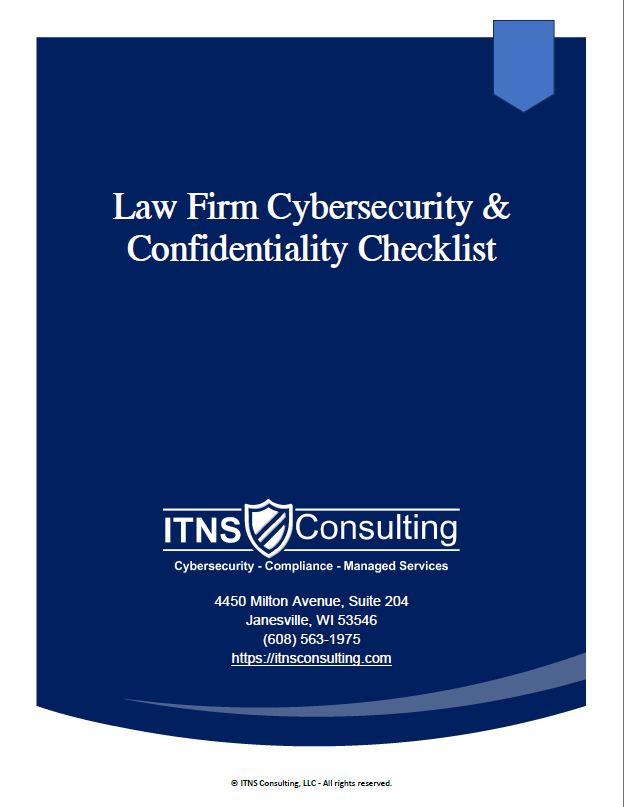
⚖️ Law Firm Cybersecurity & Confidentiality Checklist — Free Download
Protect Client Data. Strengthen Compliance. Reduce Legal Risk.
Perfect for:
✔️ Solo attorneys and small to mid‑sized firms
✔️ Firms undergoing cyber insurance renewal
✔️ Firms with remote or hybrid staff
✔️ Practices handling sensitive or regulated data
✔️ Administrators planning technology improvements