

If you own or lead a small to medium financial service organization, your business runs on trust. Clients rely on you to protect financial records, investment information, tax documents, insurance data, account details, and personal identity information. That trust can take years to build. One IT failure can damage it. That is why understanding the most serious IT risks for financial services is not just a technical concern. It is a business survival issue.
Many financial firms do not have a large internal IT department. In addition, they may lack a full-time security officer or dedicated compliance team. As a result, owners and partners often manage client service, staff productivity, vendor relationships, regulatory requirements, cyber insurance questions, and technology decisions at the same time. However, cybercriminals, regulators, and clients do not lower their expectations because your team is small.
At ITNS Consulting, we understand that financial service organizations need more than basic help desk support. Instead, you need a proactive partner that can stabilize your environment, harden your defenses, protect your data, and support compliance. Just as importantly, you also need clear guidance that does not overwhelm your team. Therefore, the risks below are the ones your firm cannot afford to ignore.
Quick Summary: The Biggest IT Risks for Financial Services Firms
The biggest IT risks for financial services firms include cyberattacks, ransomware, compliance gaps, weak access controls, phishing, vendor risk, Microsoft 365 misconfigurations, outdated systems, poor IT support, and lack of strategic IT leadership. These risks can expose client data, interrupt operations, increase audit pressure, and damage trust.
1. Cybersecurity Threats Are Targeting Financial Services Firms
Financial service organizations are attractive targets because you handle valuable information. A criminal does not need to break into a bank vault. They can trick an employee into giving up a password, compromise a cloud account, or steal client files from an unprotected system. Ransomware, phishing, account takeover, data theft, and fraudulent wire instructions are not distant enterprise problems. They are daily risks for small and medium firms.
Many firms believe they are protected because they have antivirus software, a firewall, or someone they call when something breaks. However, that is not enough anymore. For that reason, ITNS Consulting addresses this by delivering layered cybersecurity as part of a managed IT program. Our governance-first approach aligns people, processes, and technology. As a result, your security is not dependent on one tool or one person remembering to do the right thing.
2. Compliance Gaps Increase IT Risk for Financial Services
Compliance is one of the most stressful IT risks for financial services. It is not always clear what is required, what evidence must be maintained, or whether your current controls would stand up to review. Depending on your firm, you may need to address expectations connected to GLBA, the FTC Safeguards Rule, SEC guidance, FINRA requirements, cyber insurance, client due diligence, or written information security plans.
The mistake many firms make is treating compliance as a paperwork exercise. However, policies that are never implemented will not protect your firm. Likewise, risk assessments that are never updated and controls that are not monitored create exposure. Therefore, ITNS Consulting helps financial service organizations move from uncertainty to documented readiness. We map security practices to recognized frameworks, support policy and procedure development, review risk, and help produce useful evidence. Then, owners can use that evidence with auditors, insurers, regulators, or clients when needed.
3. Ransomware Can Shut Down Client Service
A ransomware attack is not just an IT event. It can stop your staff from accessing client records, email, financial applications, shared files, billing information, and critical communication tools. If your firm cannot operate for several days, the damage can grow quickly. Missed deadlines, lost revenue, client frustration, reputational harm, and reporting obligations may follow.
Backups alone are not the full answer. Instead, you need secure, monitored, and tested recovery processes. To support that goal, ITNS Consulting helps firms build practical business continuity and disaster recovery capabilities, including backup strategy, recovery planning, monitoring, and validation. Ultimately, if something happens, your firm has a plan, your data is protected, and recovery is not based on hope.
4. Weak Access Controls Put Client Data at Risk
One of the most common security weaknesses is poor control over who has access to what. Shared passwords, missing multi-factor authentication, excessive permissions, old user accounts, weak offboarding, and unmanaged administrator access all create risk. In a financial firm, one compromised account can expose client data, internal financial records, email communications, and cloud applications.
ITNS Consulting helps firms strengthen identity and access management by applying practical controls such as MFA, least-privilege access, account reviews, secure onboarding and offboarding, and Microsoft 365 security hardening. These controls reduce the chance that a single stolen password becomes a firm-wide incident.
5. Phishing and Email Fraud Create Serious Financial Risk
Email is still one of the easiest ways for attackers to reach your firm. A convincing message may appear to come from a client, custodian, bank, vendor, partner, or executive. The request may look routine: open this document, update your password, approve this payment, review this invoice, or confirm account details. By the time someone realizes it was fake, credentials may be stolen or sensitive information may already be exposed.
ITNS Consulting addresses this risk with a combination of technical controls and user education. For example, email security, endpoint protection, MFA, monitoring, security awareness, and response procedures work together to reduce exposure. At the same time, we help your team understand what to watch for while giving your systems stronger protection when someone makes an honest mistake.
6. Vendor and Software Risk Expands Your Attack Surface
Your firm likely relies on multiple third parties: CRM platforms, portfolio management systems, accounting tools, tax applications, cloud storage, custodial portals, payroll providers, email systems, document management platforms, and compliance software. Every connection matters. Every vendor that touches your data or supports your operations adds another layer of risk.
ITNS Consulting helps financial service organizations evaluate vendor risk through a governance-focused lens. We help identify where sensitive data resides, how systems connect, what access vendors have, and what controls should be in place. This includes assistance with third-party risk reviews, cloud security reviews, access controls, and documentation that supports compliance and due diligence.
7. Cloud and Microsoft 365 Misconfigurations Create Hidden Exposure
Cloud services make firms more flexible, but they also create risk when settings are not reviewed and secured. Microsoft 365, cloud file storage, shared mailboxes, remote access tools, and SaaS platforms can be safe and efficient when configured properly. They can also expose sensitive data when permissions are too broad, MFA is inconsistent, external sharing is unmanaged, or logs are not monitored.
ITNS Consulting helps financial firms secure cloud environments through baseline reviews, Microsoft 365 hardening, conditional access planning, data protection controls, backup considerations, and ongoing monitoring. However, we do not assume that because a tool is popular, it is configured safely. Instead, we verify, document, and improve the environment so your firm can use cloud technology with greater confidence.
8. Outdated Systems and Missing Patches Invite Preventable Incidents
Many breaches start with something preventable: an unpatched workstation, unsupported software, an old firewall, a forgotten server, a weak remote access tool, or a third-party application that has not been updated. Owners often do not see these issues until there is a failure, but attackers actively look for them.
ITNS Consulting reduces this risk through proactive managed IT processes that include monitoring, patch management, vulnerability awareness, lifecycle planning, and standards-based remediation. Instead of waiting for systems to fail, we help your firm maintain a healthier, more secure technology foundation. As a result, preventable issues are easier to identify and address before they become disruptions.
9. Poor IT Support Slows the Whole Firm Down
For a financial service organization, downtime is more than an inconvenience. When advisors, accountants, tax professionals, analysts, or administrative staff cannot access systems, client service suffers. Slow computers, recurring login issues, unreliable applications, printer problems, network instability, and delayed support all chip away at productivity and confidence.
ITNS Consulting provides support designed around prevention, communication, and accountability. Our managed services are built to stabilize your environment, resolve issues efficiently, and reduce repeat problems over time. We believe your IT partner should not just close tickets. They should help your firm run better.
10. Lack of Strategic IT Leadership Leaves Owners Guessing
Many owners know technology matters, but they do not always know which risks to prioritize, which projects to fund, which vendors to trust, or which controls are truly necessary. Without strategic guidance, IT decisions become reactive. You buy tools after a scare, replace systems after they fail, or respond to compliance questions at the last minute.
ITNS Consulting brings vCIO and vCISO-level guidance to small and medium financial service organizations without requiring you to hire full-time executive technology staff. We help develop a roadmap, review risk, plan budgets, support compliance priorities, and align IT decisions with business outcomes. That gives owners a clearer path forward and helps prevent technology from becoming a constant source of stress.
How ITNS Consulting Helps Reduce IT Risks for Financial Services Firms
Your firm does not need another vendor that reacts only when something breaks. You need a partner that understands how technology, cybersecurity, compliance, continuity, and business operations fit together. ITNS Consulting was built around that idea. Our process is governance-first, practical, and designed for regulated and growing organizations that need strong protection without unnecessary complexity.
ITNS Consulting helps financial service organizations reduce risk by combining proactive managed IT, cybersecurity controls, compliance support, risk and vulnerability assessments, business continuity planning, vendor oversight, Microsoft 365 security, user support, documentation, and strategic leadership into one coordinated program. That means fewer gaps, better visibility, stronger accountability, and a more predictable technology experience.
If you are worried about whether your firm is truly protected, whether your compliance documentation is audit-ready, whether your backups would recover properly, or whether your current IT provider is doing enough, those are valid concerns. The good news is that they are solvable with the right process and the right partner.
ITNS Consulting’s Four-Step Process for Reducing IT Risks
Reducing IT risks for financial services firms takes more than installing tools or responding to tickets. Instead, it requires a clear, repeatable process. That process should connect technology decisions to business goals, compliance needs, security controls, and long-term operational stability. For that reason, ITNS Consulting uses a four-step process designed to make IT simple, secure, and scalable for regulated organizations.
Step 1: Complimentary Consultation. We start by learning about your firm, your current IT environment, your business goals, your security concerns, and your compliance obligations. This gives owners a clearer view of what is working, where gaps exist, and which risks need attention first.
Step 2: Detailed Proposal. After the consultation, ITNS Consulting provides a clear proposal that outlines scope, priorities, recommended improvements, strategic roadmap items, and transparent flat-fee pricing. This helps your firm make informed decisions without surprise costs or vague recommendations.
Step 3: Onboarding Experience. Once your firm moves forward, our team handles the heavy lifting. We work to standardize systems, deploy monitoring and security tools, document the environment, configure backups, strengthen controls, and create a more stable technology foundation.
Step 4: Strategic Partnership. Our work does not end after onboarding. ITNS Consulting continues to provide proactive support, executive-level visibility, risk reviews, reporting, compliance guidance, and strategic IT leadership. This ongoing partnership helps your firm reduce downtime, strengthen security, improve compliance confidence, and plan technology decisions with greater clarity.
Reduce IT Risk Before It Becomes a Business Problem
The most significant IT risks facing financial services firms are not always the ones making headlines. More often, they are the overlooked vulnerabilities, outdated processes, unreviewed vendor relationships, undocumented procedures, and small security gaps that accumulate over time.
Organizations that take a proactive approach to cybersecurity, compliance, and technology governance are better positioned to reduce risk, maintain client confidence, and support long-term business growth. Strong controls, documented processes, employee accountability, business continuity planning, and ongoing risk assessments all play a critical role in creating a resilient technology environment.
Financial services firms succeed when clients trust them to protect sensitive information, manage risk responsibly, and maintain operational stability. Technology should reinforce that trust every day.
The goal is not simply to avoid problems. It is to build a technology foundation that supports compliance, security, continuity, and future growth.
Are Hidden Technology Risks Putting Your Firm at Risk?
Many financial services organizations do not discover technology and compliance gaps until an audit, client questionnaire, security incident, or operational disruption exposes them. If you’re unsure whether your current technology environment adequately supports cybersecurity, compliance, and risk management objectives, schedule a free consultation with ITNS Consulting. We’ll help identify practical improvements and develop a roadmap for a more secure, compliant, and resilient firm.
How Mature Is Your Compliance and Risk Management Program?
Effective risk management requires more than security tools. It requires governance, accountability, documented processes, and continuous improvement.
Download our Compliance Program Maturity Scorecard to evaluate your firm’s current compliance and risk management efforts, identify gaps, and gain a clearer understanding of your overall program maturity.
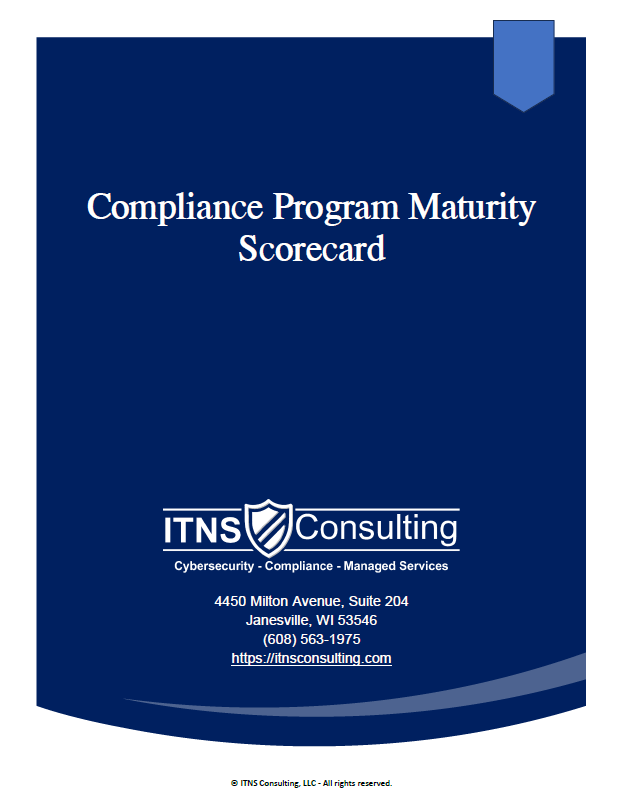
📊 Compliance Program Maturity Scorecard — Free Download
Measure Your Governance. Identify Gaps. Build a Stronger, More Predictable Compliance Program.
This scorecard breaks governance and compliance into clear maturity stages, helping you understand where your program stands and identify gaps in documentation, evidence, and control ownership.
It also helps you prioritize improvements based on risk, build repeatable governance practices, and strengthen readiness for audits, insurance reviews, and client due diligence.
Perfect for:
✔️ Small and midsize businesses building or improving compliance programs
✔️ Organizations onboarding GRC tools
✔️ Leaders preparing for regulatory or client‑driven assessments
✔️ Teams wanting clarity, structure, and accountability
✔️ Businesses striving for NIST CSF, SOC2‑lite, or insurance‑aligned maturity