

Organizations have had to make several overnight adjustments to stay afloat over the last few years. If you’re like most businesses, you may have needed solutions to support remote work and collaboration. But are those tech acceleration technologies pointing you in the right direction towards your long-term goals and vision?
A few years into the pandemic, many businesses are starting to evaluate whether the technology solutions and products they implemented to help them adapt to a remote workforce and provide a touchless customer experience are practical in the long run. For a better future, it’s critical to think beyond mere tech acceleration and embrace smart tech acceleration.
While tech acceleration is about fast implementations that fix short-term issues, smart tech acceleration focuses on implementing technology capable of supporting an organization’s long-term goals and vision.
When planning for smart tech acceleration, taking the top tech trends and emerging technologies into consideration is crucial to carry your business successfully into the future.
Top Tech Acceleration Technologies To Consider
Let’s take a look at some of the trends predicted to make waves in 2022-2023:
Total experience will be the new strategic differentiator
Total experience combines both customer and employee experiences (CX and EX). By breaking down silos and integrating technology with employees, customers and users, total experience improves the overall experience. It focuses on meeting the needs of customers and employees to achieve better, meaningful, long-term business outcomes.
According to experts, by 2026, 60% of large enterprises will use total experience (TX) to transform their business models to achieve world-class customer and employee advocacy levels.
Generative AI applications will rise
Generative AI is a catch-all term for artificial intelligence that creates new artifacts using unsupervised learning algorithms. By 2025, experts expect it to account for 10% of all data produced, up from less than 1% today. However, handle this technology with caution as it is becoming clear that it might share the same implicit biases as its developers.
Many progressive companies are now willing to pay bounties to address the problem caused by biases. For example, to address this issue, Twitter launched a bias bounty program in 2021, awarding a cash prize to a student who demonstrated that an image-cropping algorithm favored a particular face type. Despite the challenges associated with generative AI, keep in mind that, when used correctly, it can be transformative.
Smart infrastructure adoption will grow
Experts expect smart infrastructure investments to grow dramatically by 2022-2023 since it’s clear that IoT and edge technologies that run on advanced networks like 5G can enable smart, connected ports, roads, and trains. This goldmine should never be overlooked by proactive businesses since it will undoubtedly serve as a catalyst for growth.
Smart infrastructure provides a chance for small and medium businesses (SMBs) to improve their digital capabilities and make business operations more productive.
Smart infrastructure has the following advantages:
- It helps your business become more agile by facilitating seamless collaboration.
- Having greater access to more comprehensive data allows you to improve your business.
- Performance-based analytics can help you identify problem areas and improve overall efficiency and effectiveness.
Emerging Technologies Deliver the Greatest Value When Guided by Strategy
Technology continues to evolve rapidly, creating new opportunities for organizations to improve efficiency, strengthen customer experiences, increase productivity, and support long-term growth. However, not every new technology deserves immediate investment, and successful adoption requires more than simply following the latest trend.
The organizations that gain the most value from technology acceleration take a strategic approach. They evaluate business objectives, identify operational challenges, prioritize investments that deliver measurable results, and build a roadmap that supports future growth.
Whether the focus is automation, cloud solutions, artificial intelligence, cybersecurity, collaboration platforms, or other emerging technologies, success depends on aligning technology decisions with business goals.
Technology should not be adopted because it is new. It should be adopted because it helps your organization become more effective, resilient, and competitive.
Is Your Technology Strategy Ready for the Next Phase of Growth?
Many organizations know they need to modernize but struggle to determine which technologies should be prioritized and when investments should be made. If you’d like help evaluating your current environment and identifying opportunities for improvement, schedule a free consultation with ITNS Consulting. We’ll help you assess your technology landscape, prioritize initiatives, and build a practical roadmap for future success.
Build a Technology Plan That Supports Innovation
The most successful technology investments are driven by business strategy, not hype.
Download our Technology Roadmap Planner to evaluate your current technology environment, identify future priorities, and create a practical roadmap that supports innovation, operational efficiency, cybersecurity, and long-term business growth.
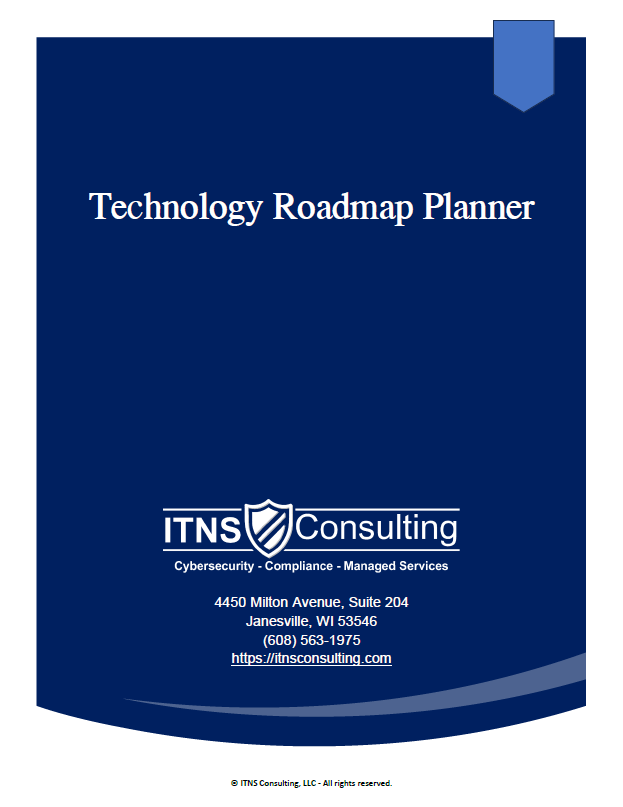
🧭 Technology Roadmap Planner — Free Download
Create a Clear, Strategic, and Measurable IT Improvement Plan
This structured planning tool helps you map IT, cybersecurity, and compliance priorities, identify outdated or high-risk systems, and document operational challenges and improvement opportunities.
It also helps you build a clear 12- or 24-month roadmap that aligns technology investments with budget cycles and communicates priorities clearly to leadership, staff, and vendors.
Perfect for:
✔️ Small business owners and general managers
✔️ Office managers and operations leads
✔️ Teams evaluating IT providers or internal processes
✔️ Organizations preparing for growth, compliance, or cyber insurance
✔️ Any business wanting more predictable, strategic IT planning