

The major upheavals of the last couple of decades, such as the global recession and the COVID-19 pandemic, have demonstrated that firms will suffer severe setbacks if their supply chains are not resilient. An entire supply chain becomes vulnerable if one component is exposed to risk, just like a house of cards will topple if one section is out of balance.
Supply chain resilience refers to an organization’s ability to use its resources to handle unanticipated supply network disruptions. In other words, it is the ability to respond to and recover from challenges without disrupting operations or deadlines.
These statistics from last year demonstrate why supply chain resilience is crucial:
- The financial impact of supply chain disruptions was substantial. Over 16% of organizations reported severe revenue loss.
- Over 10% of organizations stated that supply chain disruptions had affected their brand’s reputation.
- Nearly 10% of organizations lost their regular customers following a bad experience due to a broken supply chain.
Despite this, over 70% of organizations don’t have a business operations contingency plan to deal with disruptions lasting more than a few weeks.
4 Core Elements of a Resilient Supply Chain
A resilient supply chain incorporates the following four essential elements, regardless of industry or geographic location:
1. End-to-End Monitoring
A resilient supply chain requires continual monitoring. However, today’s organizations frequently lack awareness of what’s going on with their vendors and consumers at different levels. Vendors that are critical to a company’s success should always be closely monitored. It’s critical to identify issues before they become severe impediments, such as ransomware penetrating your network or a computer part being delayed in shipment. Knowing about issues as soon as they arise allows you to seek out other options and update customers quickly.
2. Sourcing Diversification
Even though eliminating single points of failure is a critical part of risk mitigation, many companies still rely on a single vendor, region or country in their supply chain portfolios. It’s ideal to employ a mix of near-shore and offshore vendors for each component so that if one region/vendor goes down, suppliers from other locations can step in.
3. Incident Tolerance
Security, backup and compliance postures must be strengthened to ensure operations continue even if one of the vendors/regions gets affected. The goal must be to build incident tolerance or the ability to ensure that the supply chain keeps running, regardless of the nature or scope of an incident.
4. Agility
The most successful organizations operate with an agile mindset. They work hard to keep up with market trends as well as the latest technology developments. They use the best tools and strategies in the industry to gain insights, foresee opportunities and risks, and take aggressive action ahead of their competitors.
The Key Enablers of Supply Chain Resilience
People, processes and technology are the three key enablers of a robust supply chain resilience strategy.
People
When it comes to the supply chain, a crisis management team comprised of the most skilled and resilient people must be established. By relying on organizational insights, the team must draft a response playbook and acquire appropriate technologies. Additionally, to prepare the entire organization for disruptions, the team must develop and run mock drills.
Processes
Employees perform at their best when efficient and reliable processes support them. As a result, digitizing as many processes as possible is highly recommended. This allows organizations to access large amounts of data and information in real time, which they can utilize to make decisions regarding crucial competencies required to navigate a crisis.
Technology
Technology can fine-tune the processes within an organization accurately. Using proper technologies to construct a centralized incident management system is the best method to detect issues and maintain accountability within the supply chain.
Supply Chain Resilience Starts with Understanding Your Dependencies
Every organization depends on vendors, suppliers, software providers, service partners, and other third parties to keep operations running smoothly. While these relationships create opportunities for growth and efficiency, they can also introduce risks that affect business continuity, cybersecurity, compliance, and customer service.
The most resilient organizations take a proactive approach to understanding those dependencies. They identify critical vendors, review access privileges, evaluate security practices, document recovery expectations, and regularly assess how disruptions could affect operations.
Supply chain resilience is not about eliminating risk entirely. It is about creating visibility into the relationships and dependencies that support your business so you can respond effectively when unexpected challenges arise.
Organizations that understand their supply chain risks are often better positioned to reduce disruption, maintain customer confidence, and recover more quickly when incidents occur.
Could a Vendor Disruption Impact Your Business?
Many organizations rely heavily on vendors and third-party providers without fully understanding the risks those relationships may introduce. If you’re unsure whether your supply chain is resilient enough to withstand cybersecurity incidents, service disruptions, vendor failures, or compliance challenges, schedule a free consultation with ITNS Consulting.
We’ll help you identify critical dependencies, evaluate third-party risks, and develop a practical strategy for strengthening supply chain resilience and business continuity.
How Much Access Do Your Vendors Really Have?
Third-party vendors often have access to systems, applications, data, and business processes that are critical to daily operations. Without proper oversight, those relationships can create unnecessary risk.
Download our Vendor Access Review Template to evaluate vendor permissions, identify unnecessary access, and strengthen your organization’s approach to third-party risk management and supply chain resilience.
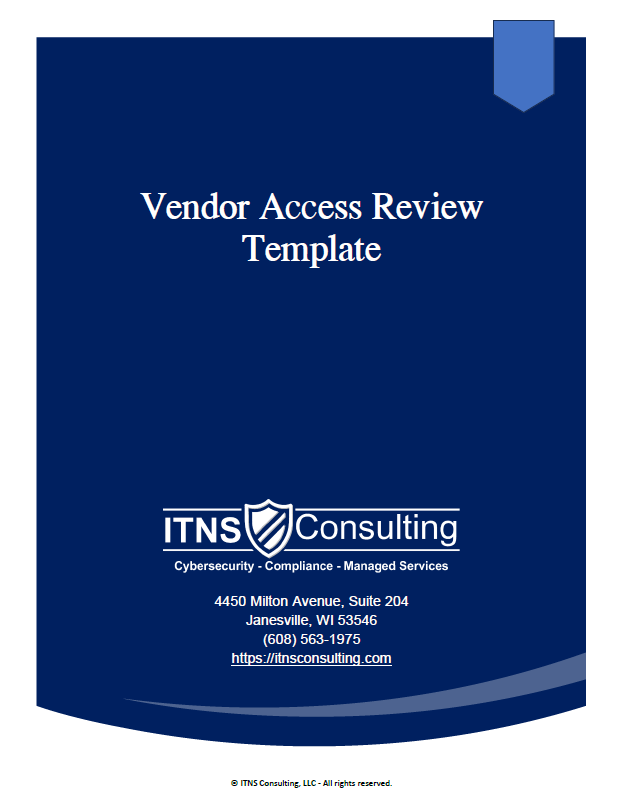
🔐 Vendor Access Review Template — Free Download
Know Who Has Access. Reduce Third Party Risk. Strengthen Your Security.
This template provides a clear, organized way to document every vendor with system or data access, identify excessive permissions, evaluate risk levels, and define security and support responsibilities.
It also helps you track critical safeguards, review offboarding procedures, and record changes and follow-up actions so vendor access remains secure and accountable.
Perfect for:
✔️ Small and mid-size businesses
✔️ Companies preparing for cyber insurance renewal
✔️ Teams undergoing vendor due‑diligence from clients or partners
✔️ Organizations evaluating current IT or SaaS usage
✔️ Leaders wanting strong governance and predictable security