Cyber criminals know that small businesses are less likely to have strong security measures in place, making it easier for them to breach their data. In this blog post, you’ll learn the steps you can take to protect your business from the claws of cyber criminals.
Follow These Cyber Incident Prevention Best Practices
While there is no single silver bullet for preventing all incidents, there are some best practices that can help you reduce the risk of falling victim to a cyber attack.
1. Ensure your cybersecurity policy supports remote work
When implementing a cybersecurity policy supporting remote work, consider the following:
- How will employees access company resources off-site?
- What security measures should be put in place to protect company data?
- How will remote employees collaborate and share data?
Additionally, you should identify any support mechanisms to help employees struggling to adjust to remote work. By taking these factors into account, you can create a cybersecurity policy that is productive, seamless and secure.
2. Provide cybersecurity awareness training for employees
Implementing a security awareness training program for employees is critical in today’s digital age. As a responsible business executive, you must strive to ensure that the program is comprehensive, engaging and adaptable to new threats.
3. Deploy software patches
Threats to your network security are becoming more prevalent as technology advances. That’s why it’s critical to keep your software up to date with the latest security patches. There are two different ways to keep your software up to date. One way is to set your software to update automatically while the other is to manually check for updates on a regular basis.
4. Have active antivirus and anti-malware protection
There are numerous antivirus and anti-malware solutions in the market, so select one that is appropriate for your company. When doing so, you’ll have to consider the size of your company, the type of data you need to safeguard and your budget. Once you’ve decided on a solution, make sure you follow through with it. This includes installing it on all your company’s computers and keeping it updated.
5. Implement multi-factor authentication (MFA)
Multi-factor authentication is a security measure that requires users to provide more than one form of identification when accessing data, thus reducing the chances of unauthorized data access. This can include something that the user knows (like a password), something that the user has (like a security token) or something that the user is (like a fingerprint).
6. Use a virtual private network (VPN)
A virtual private network encrypts your company’s data and allows you to control who has access to it. This can help prevent data breaches and keep your company’s information safe. However, make sure to choose a reputable provider that offers robust security features.
7. Deploy single-sign-on (SSO) and password management
A single sign-on solution can make your users’ login process easier by allowing them to log in once to a central system and then access all the other applications and systems they require. This can make the login process more efficient for them. In addition to SSO, a password management solution simplifies the user login process by allowing them to manage their passwords more securely and efficiently.
8. Encrypt your data – Data encryption is the process of converting information into a code that can only be deciphered by someone who has the key to decrypt it. It is done to prevent unauthorized individuals from accessing the information. Data encryption is a critical tool in cybersecurity since it can help reduce the exposure of your data to risks and ensure compliance with data privacy regulations.
9. Have backup and disaster recovery solutions – It is critical to have backup and disaster recovery solutions in place in case of system failure or data loss. Make sure to research the different options and find the best solution for your company. To ensure that your backup and disaster recovery solutions are working correctly, test them on a regular basis.
Prevention Is Always Easier Than Recovery
Cyber incidents can disrupt operations, expose sensitive information, damage customer trust, and create significant financial consequences. While no organization can eliminate every threat, businesses that focus on strong cybersecurity fundamentals are often far better positioned to prevent incidents before they occur.
Effective cyber incident prevention requires more than a single security tool. It involves a combination of employee awareness training, strong authentication practices, timely software updates, secure backups, access controls, ongoing monitoring, and regular risk assessments. When these controls work together, they create multiple layers of protection that make it significantly harder for attackers to succeed.
The most resilient organizations understand that cybersecurity is not a one-time project. It is an ongoing commitment to reducing risk, improving security practices, and adapting to an evolving threat landscape.
The best way to respond to a cyber incident is to prevent it from happening in the first place.
Is Your Business Following Cybersecurity Best Practices?
Many small businesses know cybersecurity is important but remain unsure whether their current safeguards provide adequate protection against today’s threats. If you’d like help evaluating your security posture and identifying opportunities for improvement, schedule a free consultation with ITNS Consulting.
We’ll help assess your current environment, identify potential vulnerabilities, and develop a practical roadmap for strengthening your cybersecurity defenses before a cyber incident impacts your business.
Build a Stronger Cybersecurity Foundation
Many cyber incidents succeed because of overlooked vulnerabilities and preventable security gaps.
Download our Cybersecurity Baseline Checklist to evaluate essential security controls, identify opportunities for improvement, and take practical steps to better protect your business from today’s evolving cyber threats.
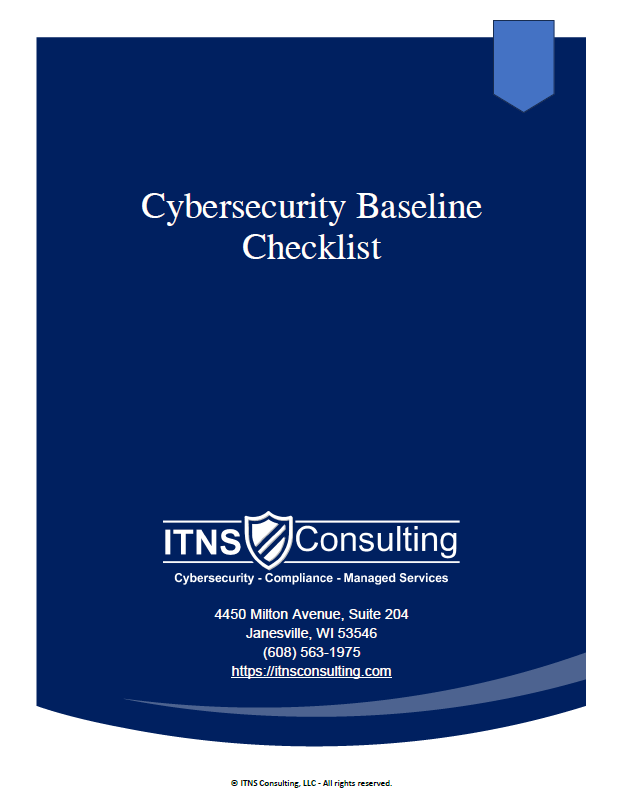
🛡️ Cybersecurity Baseline Checklist — Free Download
Understand Your Current Security Posture. Identify Gaps. Strengthen Your Defenses.
This straightforward, business-friendly checklist helps you evaluate your current security posture in minutes and identify weak points before attackers can exploit them.
It also helps you prioritize the most impactful fixes while strengthening compliance, cyber insurance readiness, and operational resilience.
Perfect for:
✔️ Small businesses getting started with cybersecurity
✔️ Leaders evaluating internal or outsourced IT performance
✔️ Teams preparing for growth, compliance, or insurance renewal
✔️ Organizations wanting predictable, repeatable security practices