Global events, such as recessions and pandemics, create enormous social and economic challenges that impact organizations and their management. From employee and customer satisfaction to financial difficulties, supply chain disruption and skyrocketing cyber attacks, top-level management oversees a wide range of concerns. Many business owners are talking about organizational resilience in these trying times and acknowledging Cyber Resilience as a first step to organizational resilience.
As business owners aim to address multiple challenges that may be a threat to their organizations’ success, resilience is a trending buzzword. Organizational resilience is an organization’s ability to foresee, plan for, respond to and adapt to gradual change and unexpected disruptions to survive and thrive.
Even during the most recent COVID-19 pandemic, organizations that already practiced methods to cultivate resilience through remote/hybrid work, digital acceleration and more, showed that they can quickly recover from setbacks and have an advantage over competitors.
If you want to prioritize resiliency within your own business, one of the first steps you should take is building cyber resilience. Cyber resilience refers to an organization’s ability to consistently deliver the desired outcome in the face of adverse cyber events.
Cyber Resilience Powers Transformation
According to Forrester, cyber resilience is more than just a security imperative. It’s the foundation of a strong business and brand. This is one of the reasons why over 65% of organizations are investing in improving their cyber resiliency posture. Businesses across the globe have begun to realize that it’s time to look inward and identify and close security gaps to build a more resilient future.
While establishing cyber resilience, consider the following:
- You must deploy tools to detect, evaluate and handle network and information system risks, including those that affect your supply chain.
- It’s critical to identify irregularities and potential cybersecurity issues through continuous network and information system monitoring before they morph into severe threats.
- Implementing an incident response strategy is crucial to ensure operational continuity where you can bounce back quickly even if you are the victim of a cyber attack.
- Always ensure that your cyber resilience strategy is overseen by top management and integrated into day-to-day operations.
Companies that invested in cyber resilience expected to get the following results:
- Increased secure collaboration within the organization
- Better preparedness, response and/or remediation skills in the event of a security incident
- Improved integration of people, processes and technology
How to Improve Your Cyber Resilience
1. Employee Training
Providing continual security awareness training to your employees enables them to identify threats and vulnerabilities. It enhances employees’ defensive abilities and prepares them to effectively deal with a crisis.
2. Stay Current With Technological Advances and the Threat Landscape
It’s crucial to keep up with the latest technology developments and threats. If you have no understanding of what you’re up against, you can’t protect your business.
3. Reset Your Security Systems
Regularly audit your digital and physical systems to identify vulnerabilities. Set the critical systems to their best available configurations to prevent unauthorized access.
4. Adopt Advanced Technologies
Legacy technologies may be ineffective in dealing with today’s challenges. As a result, having the most up-to-date and effective technologies and tools to secure your organization is critical.
5. Partner with an Outsourced Security Provider
Resiliency is no longer a choice but a necessity. However, it requires a significant amount of time, effort and expertise. It’s always best to collaborate with an expert partner like ITNS Consulting who can handle all resiliency and technology matters for you.
Cyber Resilience Is the Foundation of Organizational Resilience
Every organization faces disruption. Whether it comes from a cyberattack, system failure, human error, vendor outage, or unexpected business event, the ability to respond and recover often determines how significant the impact will be.
Cyber resilience is about more than preventing incidents. It is about ensuring your organization can continue operating when challenges arise. Strong cybersecurity controls, reliable backups, documented recovery procedures, employee awareness, risk management, and business continuity planning all contribute to a more resilient organization.
The most successful businesses understand that resilience is not built during a crisis. It is built beforehand through preparation, planning, testing, and continuous improvement.
Organizations that invest in resilience today are often better positioned to protect customers, maintain operations, and recover more quickly when disruptions occur.
How Resilient Is Your Organization?
Many businesses invest in cybersecurity tools but never evaluate whether they could continue operating during a significant disruption. If you’re unsure whether your backup strategy, recovery processes, cybersecurity controls, and business continuity plans are sufficient, schedule a free consultation with ITNS Consulting.
We’ll help assess your current environment, identify potential weaknesses, and develop a practical roadmap for improving cyber resilience, business continuity, and operational recovery readiness.
Could Your Business Recover from a Major Disruption?
Cyber resilience depends on more than prevention. It depends on your ability to recover quickly and continue serving customers when unexpected events occur.
Download our Backup & Disaster Recovery Preparedness Checklist to evaluate your current backup and recovery capabilities, identify potential gaps, and strengthen your organization’s ability to recover from cyber incidents, system failures, and other business disruptions.
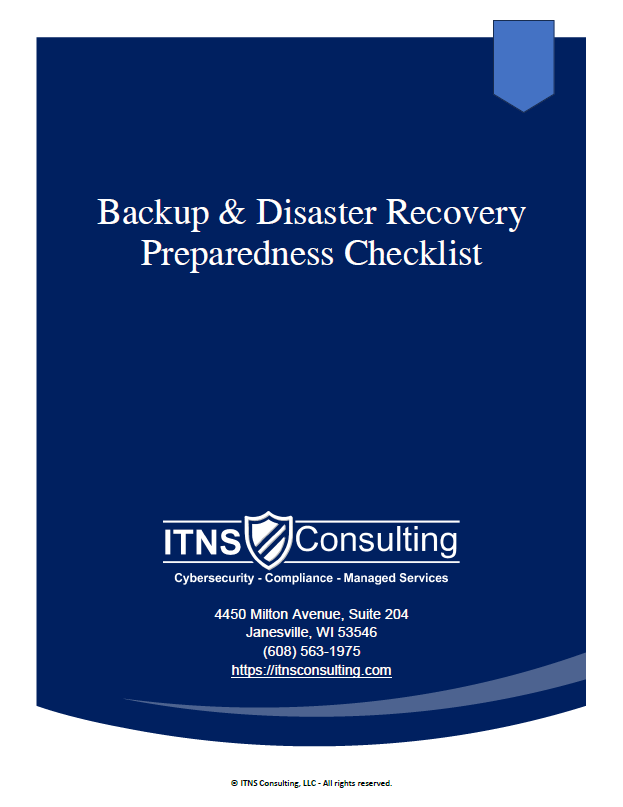
💾 Backup & Disaster Recovery Preparedness Checklist — Free Download
Be Ready for the Inevitable: Outages, Mistakes, Cyberattacks & Hardware Failures
This checklist helps leaders verify the reliability of their backup & recovery posture by highlighting the items that matter most: integrity, separation, testing, documentation, and clear expectations.
Perfect for:
✔️ Small and midsize businesses
✔️ Organizations preparing for cyber‑insurance renewal
✔️ Teams evaluating current IT providers
✔️ Companies with compliance or uptime requirements
✔️ Businesses that cannot afford downtime or data loss