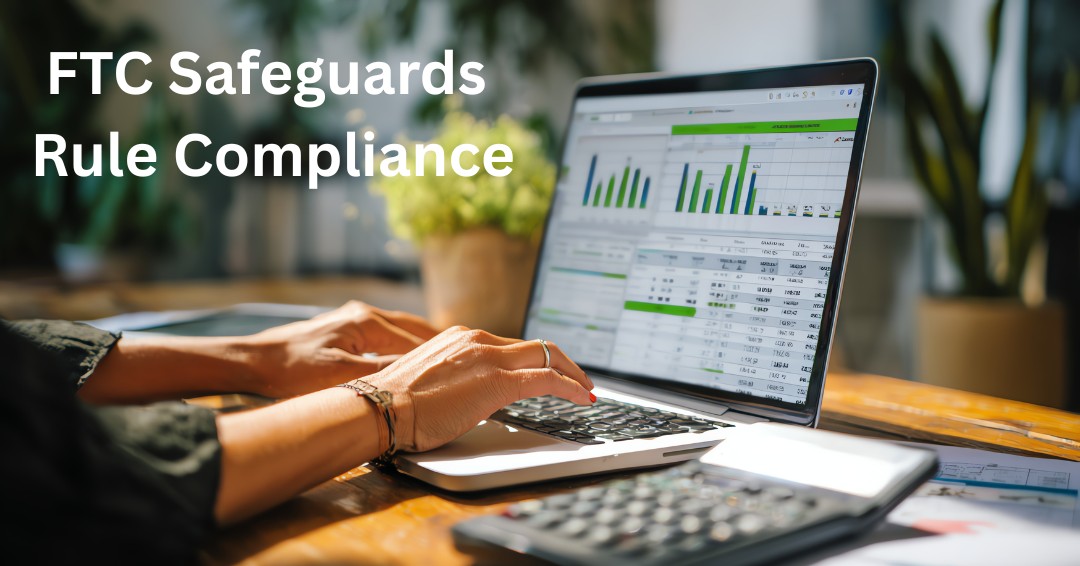


FTC Safeguards Rule compliance is no longer a background IT issue for financial service owners. If your firm handles client financial information, the Safeguards Rule may affect your business directly. This includes tax records, investment details, loan documents, account information, credit reports, Social Security numbers, and other nonpublic personal information. The rule can shape how your firm protects data, manages risk, oversees vendors, trains employees, and responds to security incidents. For financial professionals, this is not just a regulatory checkbox. It is about protecting client trust, preserving your reputation, and showing that your firm takes cybersecurity seriously.
Many financial service owners tell us the same thing: “We know cybersecurity is important, but we are not sure what regulators expect.” Documentation requirements can feel just as unclear. In some cases, firms also do not know whether their current IT provider is helping them comply. That uncertainty is understandable. After all, the FTC Safeguards Rule uses terms like information security program, risk assessment, qualified individual, service provider oversight, encryption, access controls, monitoring, and incident response. While those phrases can sound technical, the business question is simple: can your firm show that it has a reasonable, documented, and actively managed process for protecting customer information?
Why the FTC Safeguards Rule Matters to Financial Professionals
The FTC Safeguards Rule applies to many businesses the FTC considers financial institutions. That can include certain financial advisors, mortgage brokers, lenders, tax preparation firms, credit counselors, collection agencies, account servicers, and related businesses. More importantly, the rule’s definition is broader than many owners expect. Even if your firm does not think of itself as a bank, obligations may still apply when you collect, process, store, or transmit sensitive financial information.
For small and mid-sized financial service firms, the challenge is practical. Day to day, you are already managing client relationships, staff, deadlines, compliance requests, software platforms, vendors, insurance requirements, and operations. Without a full-time compliance department or internal cybersecurity team, these responsibilities can be difficult to organize. Still, regulators, clients, cyber insurers, and business partners expect more than informal security practices. They expect a program that is written down, maintained, reviewed, tested, and improved.
The Real Problem: Most Firms Have Tools, Not a Compliance Program
A common mistake is assuming that antivirus software, Microsoft 365, a firewall, backups, or a password manager automatically equals compliance. Those tools may be important, but tools alone do not create a defensible program. FTC Safeguards Rule compliance requires structure. Your firm needs to know what customer information it has and where that information lives. It also needs to know who can access it, what risks exist, what safeguards are in place, how employees are trained, how vendors are reviewed, and what happens if something goes wrong.
This is where many firms get stuck. The owner may assume the IT vendor is handling security. At the same time, the IT vendor may assume the owner is handling policy decisions. Employees often assume cloud systems are secure by default. Vendors may assume the firm has reviewed access permissions. In the end, no one has a complete picture of risk, documentation, responsibilities, or evidence. That gap is where ITNS Consulting helps. We help financial service firms move from scattered technology decisions to a structured cybersecurity and compliance process.
What FTC Safeguards Rule Compliance Requires in Practical Terms
At a high level, the rule expects covered firms to develop, implement, and maintain a written information security program. That program must be designed to protect customer information. In plain language, your firm needs a living security program that matches its size, complexity, operations, and risk profile. A generic template that sits untouched in a folder is not enough. Instead, the program should reflect how your firm actually works. That includes your systems, staff, vendors, remote access, client portals, email workflows, backups, devices, and incident response expectations.
Important areas include assigning a qualified individual to oversee the program and conducting a risk assessment. The program should also address safeguards, monitoring and testing, employee training, service provider oversight, and ongoing updates. Written incident response procedures are also important. In addition, the FTC requires certain covered businesses to notify the FTC after qualifying security incidents. This applies when unencrypted customer information affecting at least 500 consumers is acquired without authorization.
For a financial professional, the question is not simply, “Do we have security?” A stronger question is, “Can we prove that our firm has identified its risks, implemented safeguards, trained our people, reviewed our vendors, monitored our environment, and documented our decisions?” That proof matters during client questionnaires, cyber insurance renewals, regulatory inquiries, merger discussions, vendor reviews, and security incidents.
Problem 1: You Do Not Have a Written Information Security Program
Many financial service firms have security practices, but those practices are informal. One employee may know how backups work. Another employee may manage client files. The owner may approve software purchases. The IT provider may configure email. Yet there may be no single written program that explains how the firm protects customer information. That creates risk. Undocumented practices are hard to audit, hard to improve, and hard to defend.
ITNS Consulting helps firms develop practical security policies and procedures that support FTC Safeguards Rule compliance. This work does not need to overwhelm the business. We help document how sensitive information is handled, how access is granted and removed, how systems are protected, and how employees are trained. We also document how incidents are reported and how the program is reviewed over time. The goal is not paperwork for the sake of paperwork. It is usable documentation that reflects your real operations and gives your firm a stronger compliance foundation.
Problem 2: You Have Not Completed a Meaningful Risk Assessment
A risk assessment is one of the most important parts of a compliance program. It identifies what could go wrong before the issue becomes a breach, outage, or client-facing problem. A meaningful assessment reviews email security, access permissions, cloud applications, endpoint protection, remote work, vendor access, password practices, data storage, backups, physical safeguards, employee behavior, and incident response readiness.
ITNS Consulting provides risk and vulnerability assessments that help firms identify gaps, prioritize fixes, and build a realistic roadmap. This may include finding former employees who still have access. It may also uncover accounts without multi-factor authentication, devices missing security updates, unsupported software, weak backup practices, over-permissioned users, or vendors with unclear responsibilities. From there, we help translate technical findings into business decisions. Owners can then understand what matters most and what to address first.
Problem 3: Access Control Is Too Loose
Financial firms depend on email, document portals, accounting platforms, CRM systems, tax software, custodian platforms, loan systems, and cloud file storage. If access is not properly controlled, one compromised password can expose sensitive client information across many systems. Because of that risk, the FTC Safeguards Rule expects firms to control who can access customer information. It also expects firms to limit access to what each person needs for their role.
ITNS Consulting helps implement and manage multi-factor authentication, least-privilege access controls, account reviews, secure remote access, Microsoft 365 security hardening, password management practices, and offboarding procedures. For financial service owners, that solves a real problem. Better access control gives you a clearer view of who can see client data, how accounts are protected, and how quickly access is removed when someone leaves the firm.
Problem 4: Employees Are Not Trained for Today’s Threats
Cybercriminals do not need to break through a firewall if they can trick someone into taking action. A single fraudulent message may try to get an employee to click a malicious link, approve a fake login prompt, open a harmful attachment, or send money. Financial professionals are especially attractive targets because their communications often involve money movement, tax information, client records, signatures, approvals, and confidential documents.
ITNS Consulting provides security awareness training, employee education, phishing guidance, and practical security best practices. These services are tailored to the way financial firms operate. With the right training, employees can recognize suspicious messages, protect credentials, report incidents quickly, and understand why security procedures matter. A trained employee can become one of your strongest safeguards instead of your weakest link.
Problem 5: Vendor Oversight Is Incomplete
Your firm may rely on outside vendors for cloud storage, tax software, portfolio management, custodial integrations, payroll, compliance tools, phone systems, email filtering, payment processing, document management, and IT support. Each vendor may have access to client information, systems, or business processes. Under the Safeguards Rule, service provider oversight matters. Because of that responsibility, your firm must take steps to ensure customer information is protected.
ITNS Consulting assists with vendor risk management by helping firms identify critical vendors, document access, review security expectations, evaluate risks, and build repeatable oversight practices. This gives financial service owners a better way to answer important questions. Which vendors can access client information? What safeguards do they use? What happens if they experience a breach? Do our agreements and internal documentation support our compliance obligations?
Problem 6: Backups and Incident Response Have Not Been Tested
Ransomware, accidental deletion, business email compromise, cloud outages, hardware failure, and vendor disruptions can all affect your ability to serve clients. A backup strategy that has not been tested may fail when you need it. Likewise, an incident response plan that employees have never seen may fail during a real emergency. To reduce that risk, financial firms need confidence that they can detect, respond to, recover from, and document security incidents.
ITNS Consulting supports backup and disaster recovery planning, incident response readiness, endpoint protection, continuous security monitoring, patch management, and recovery testing. Before an incident occurs, we help firms answer practical questions. Who is notified? Who makes decisions? How are systems restored? How is client communication handled? What evidence must be preserved? How does the firm document its response?
FTC Safeguards Rule Compliance Is Also a Client Trust Issue
Your clients may never ask about the technical details of endpoint detection, encryption, conditional access, vendor reviews, or backup immutability. They do care whether their information is safe. They also care whether your firm can keep operating if systems go down. Just as important, they care whether their tax records, account details, financial plans, loan documents, or personal information are protected. A clear security program strengthens confidence. That includes written policies, trained employees, monitored systems, documented safeguards, and a trusted cybersecurity partner.
FTC Safeguards Rule compliance should not be viewed only as a regulatory burden. Done properly, it becomes a business advantage. It helps you respond to client due diligence questions. It also supports cyber insurance applications. The same program can reduce the chance of preventable incidents, create internal accountability, and give leadership better visibility into technology risk. Most importantly, it reinforces a clear message: your firm protects client information by design, not by assumption.
How ITNS Consulting Helps Financial Service Firms Move Forward
ITNS Consulting helps financial service firms build practical cybersecurity and compliance programs that align with real operations. Our process combines Managed IT, cybersecurity, compliance support, and strategic guidance. As a result, your firm is not left trying to connect disconnected pieces on its own. We help assess current risk, harden systems, document policies, train employees, review vendors, strengthen backups, monitor threats, and create a roadmap for continuous improvement.
For a busy financial professional, that matters. You should not have to become a cybersecurity engineer to meet your responsibilities. What you need is a partner who can explain risks in plain language, prioritize the work, implement the right controls, and help maintain supporting documentation. With the right support, ITNS Consulting helps move your firm from reactive IT support to proactive risk management.
Your firm may be starting from scratch. It may also be improving an existing program, preparing for insurance renewal, responding to client security questions, or trying to understand how the rule applies. In each situation, the first step is understanding your current state. From there, ITNS Consulting can help you identify gaps, assign priorities, and implement safeguards. The right safeguards should be manageable, documented, and aligned with your firm’s business goals.
FTC Safeguards Rule Compliance Requires Documentation, Not Assumptions
FTC Safeguards Rule compliance is about more than satisfying a regulatory requirement. It is about demonstrating that your firm has implemented reasonable, documented, and actively managed safeguards to protect customer information and reduce business risk.
The most effective compliance programs combine risk assessments, documented controls, employee awareness, vendor oversight, incident response planning, and ongoing review. Firms that take a proactive approach to compliance are often better positioned to reduce risk, respond to audits confidently, and strengthen client trust.
Compliance should not be viewed as a one-time project. It is an ongoing commitment to protecting sensitive information and maintaining accountability as technology, threats, and regulatory expectations evolve.
Financial services firms that invest in governance and documentation today are often the ones best prepared for tomorrow’s compliance challenges.
Could Your Firm Demonstrate FTC Safeguards Rule Compliance Today?
Many financial services organizations have implemented security controls but remain unsure whether their documentation, policies, and compliance evidence would withstand regulatory scrutiny. If you’re uncertain where gaps may exist, schedule a free consultation with ITNS Consulting. We’ll help you evaluate your current environment, identify compliance gaps, and develop a practical roadmap for strengthening your security and compliance program.
Could You Prove Compliance If Asked Today?
Meeting FTC Safeguards Rule requirements is important, but being able to demonstrate compliance is equally critical.
Download our Compliance Evidence Checklist to identify the documentation, risk assessments, policies, training records, vendor reviews, and supporting evidence commonly needed to support audits, examinations, and compliance reviews.
📂 Compliance Evidence Checklist — Free Download
Know What Proof You Need. Avoid Gaps. Stay Audit Ready.
It helps you organize what auditors and insurers expect, strengthen governance, reduce operational risk, and prepare for assessments, renewals, or vendor reviews.
Perfect for:
✔️ Businesses preparing for cyber‑insurance renewal
✔️ Organizations working toward NIST CSF alignment
✔️ Teams with limited internal IT/compliance resources
✔️ Providers handling sensitive or regulated data
✔️ Anyone who wants predictable, repeatable IT governance