While there is an over-arching belief that data isn’t really “stolen” in a ransomware breach, no organization hit with ransomware has been able to back this up as fact. That’s why compliance regulations mandate businesses to notify their clients if their data is in jeopardy.
From a data regulator’s perspective, it is the responsibility of your business to keep data safe from cyberthreats, inform clients about a breach within a stipulated period and provide necessary documentation as proof of your efforts. Although different regulations have laid down distinct mandates for breach notifications, the principle remains intact.
Many businesses, however, tend to operate in something of a “grey area” when it comes to notifying their stakeholders about data breaches. In this blog post, we’ll tell you why going down this route can backfire and why your business needs to adopt an inclusive approach that combines the best of cybersecurity and compliance.
The Grey Area
Many businesses seem to think that not all ransomware attacks need to be reported since not all hackers can decrypt the data they have encrypted themselves. They assume that only during sophisticated attacks do hackers possess the necessary skills to decrypt, exfiltrate and misuse data. Only in such cases do these businesses accept that a breach has occurred and is, hence, in need of reporting.
However, this assumption is dangerous for two reasons. First, with enhanced ransomware-as-a-service tools readily available in the market, even a hacker with minimal skills can catch you off guard and wreak havoc. Second, regulatory agencies perceive the situation differently.
For example, as per HIPAA’s Privacy Rule, the U.S. Department of Health and Human Services has advised companies to assume that ransomed data contains Personal Health Information, even in “low probability” cases. In fact, some data breach notification regulations mandate businesses to notify customers even in the case of “unauthorized access,” without the need to prove that personal data was stolen.
Why Businesses Choose Silence Over Breach Notification
Accepting a data breach isn’t easy for any business due to the severe financial and reputational repercussions. But there are other reasons why businesses choose to keep quiet.
Inability To Comply With Data Breach Notification Norms
Despite being a basic requirement, most businesses lack the ability to adhere to breach notification norms set by several regulations worldwide. Even if a business avoids reporting a ransomware attack, failing to notify its customers or clients on time can still invite stringent action from regulators.
GDPR — the European Union’s data privacy and protection regulation — has set a 72-hour deadline to report the nature of a breach and the approximate number of data subjects affected. From the moment a business’ IT team establishes that a breach has occurred, the clock starts ticking.
Is your business capable of adhering to such norms?
The “Victim Versus Victimizer” Perception
Let’s assume a business reported a ransomware breach to its stakeholders and the relevant authorities. On one hand, law enforcement agencies investigating the matter would perceive the business as a victim, even if it paid the ransom; on the other hand, regulators might deem the business to be the victimizer of its customers for failing to protect their data.
If the business is found to be non-compliant with the necessary security mandates after an audit, the regulators will undertake punitive action after assessing a list of factors.
Reputational Damage
Most customers prefer not to engage with a brand following a data breach. Who would like to associate with a business that can’t protect itself?
While your business could still recover from the financial damage caused by ransomware-induced downtime, rebuilding its reputation and regaining the trust of your customers is a long, tedious and more often than not, futile process. This is one of the main reasons why businesses abstain from reporting a ransomware breach.
Ransomware Preparedness Requires Both Security And Compliance
Ransomware is no longer just a cybersecurity problem. Increasingly, organizations must assume that a ransomware incident may also involve data exposure, regulatory obligations, customer notifications, legal considerations, and reputational risk.
The most resilient organizations recognize that recovery depends on more than restoring systems. It also requires documented security controls, incident response procedures, employee awareness, risk management practices, and the ability to demonstrate that reasonable safeguards were in place before the incident occurred.
Organizations that combine strong cybersecurity fundamentals with mature compliance practices are better positioned to reduce risk, respond effectively, and maintain the trust of customers, partners, regulators, and insurers.
Preparing for ransomware means preparing for both the technical and business consequences of a breach.
Could Your Organization Prove It Was Prepared?
Many businesses focus on preventing ransomware but never evaluate whether they could demonstrate compliance, respond to a breach investigation, or provide evidence of their security program if an incident occurred.
If you’re unsure whether your current cybersecurity and compliance efforts would stand up to regulatory scrutiny, schedule a free consultation with ITNS Consulting. We’ll help you identify potential gaps, evaluate your preparedness, and develop a practical roadmap for strengthening both your security posture and compliance readiness.
Could You Demonstrate Compliance After a Security Incident?
When a ransomware attack becomes a potential data breach, regulators, customers, insurers, and auditors often want evidence that appropriate safeguards were in place.
Download our Compliance Evidence Checklist to identify the policies, procedures, risk assessments, training records, incident response documentation, and supporting evidence your organization should maintain to demonstrate compliance and security readiness.
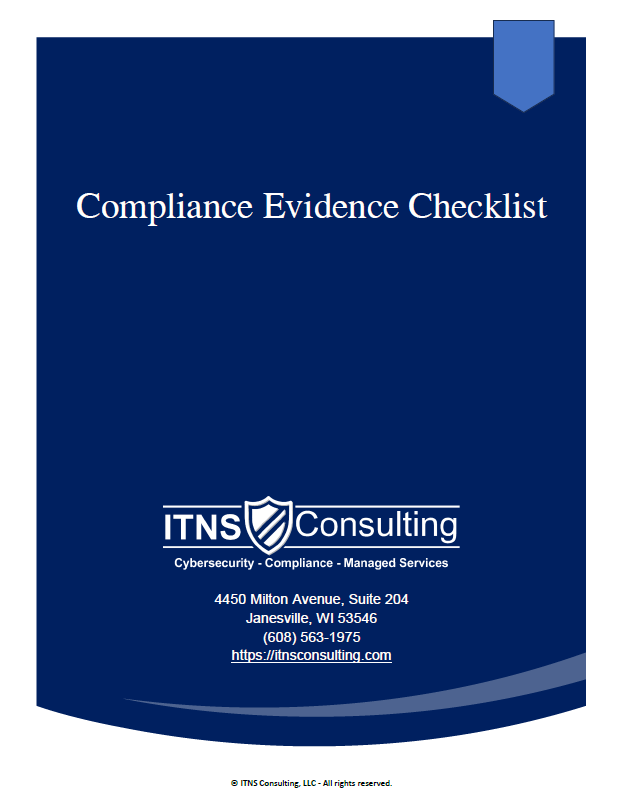
📂 Compliance Evidence Checklist — Free Download
Know What Proof You Need. Avoid Gaps. Stay Audit Ready.
It helps you organize what auditors and insurers expect, strengthen governance, reduce operational risk, and prepare for assessments, renewals, or vendor reviews.
Perfect for:
✔️ Businesses preparing for cyber‑insurance renewal
✔️ Organizations working toward NIST CSF alignment
✔️ Teams with limited internal IT/compliance resources
✔️ Providers handling sensitive or regulated data
✔️ Anyone who wants predictable, repeatable IT governance