Dealing with a cybersecurity disaster is difficult and brings forth a lot of uncertainty, especially when it involves financial and reputational damage. This holds true for all organizations, and especially for small and medium-sized businesses (SMBs). SMBs are increasingly becoming prime targets for hackers because they consider these organizations to have insufficient expertise and resources to prevent and respond to attacks. Now, more than ever, it is critical for business owners to protect their customers’ personal information, especially as we approach the holiday season when individuals purchase a lot more than at any other time of the year. This is where the Payment Card Industry Data Security Standard (PCI-DSS) finds its relevance.
Over the last year, many organizations struggled to keep their private data secure against cyber threats as they rushed to adapt to pandemic-inspired shifts in workforce and operations. Cyber crime is becoming increasingly prevalent, and the sophistication and volume of cyber attacks is escalating as well. According to a report, over 300 million ransomware attacks occurred in 2020.
Why Is PCI-DSS Important?
Organizations that accept payment cards and handle, transmit or retain payment card data must comply with PCI-DSS. It is crucial for data security because practically every business accepts credit or debit cards as a form of payment.
The PCI-DSS’s directives limit the risk of credit and debit card data loss. It not only helps avoid identity theft but also includes best practices for recognizing, preventing and resolving data incidents.
PCI-DSS compliance also safeguards a company in the event of a data breach in which cardholder data is exposed. SMBs that comply with PCI-DSS are recognized by Visa, Mastercard, Discover, JCB and American Express, all of which are pioneers in establishing this information security standard.
Failure to comply with PCI-DSS can result in penalties that prevent a company from dealing with card data.
PCI-DSS has 12 requirements:
1. Maintain firewalls for business devices
Firewalls efficiently prevent unauthorized entities from accessing sensitive data. These anti-hacking systems are usually the first line of protection against intruders.
2. Change vendor-supplied passwords
Hackers can easily crack generic passwords in products like routers and point of sale (POS) terminals. To comply with PCI-DSS, organizations must change vendor-supplied passwords and keep track of password-required equipment.
3. Encrypt transmissions of consumer data
When transferring card data over an open or public network, you must encrypt it and know where the data will be sent to and received from.
4. Use updated antivirus software
Antivirus software must be installed on all systems, both on-site and off-site. To detect complex viral threats, you must keep them updated regularly.
5. Protect stored consumer data
All cardholder data must be encrypted, truncated, tokenized or hashed using industry-standard techniques backed by a robust encryption key management process.
6. Restrict access to consumer data
Access to cardholder data should be denied to anyone who does not require it for essential tasks.
7. Maintain secure systems and apps
Safety must be ensured for systems or applications that store, process or transmit cardholder data.
8. Make cardholder data available only on a need-to-know basis
For effective access control, you must be able to grant and restrict access to cardholder data systems.
9. Create a unique ID for every person with business computer access
Ensure that each authorized user has a unique identifier and a complex password. This ensures that any access to cardholder data can be traced back to a recognized user, ensuring accountability.
10. Monitor access to network and consumer data
All systems must have proper audit policies in place with logs sent to a secure central server. A daily inspection of these logs helps detect anomalies and suspicious activity.
11. Test data security regularly
Testing on a regular basis ensures that your environment is evolving to meet the ever-changing threat landscape.
12. Maintain a data security policy
You must have an information security policy in place that is reviewed at least once a year and communicated to all employees, vendors and contractors.
The PCI Compliance Levels
There are four levels of PCI compliance that are determined by the number of transactions an organization processes each year.
Level 1 Merchants: Through all channels, they process over six million card transactions every year (card present, card not present, eCommerce).
Level 2 Merchants: Through all channels, they process about one to six million card transactions every year (card present, card not present, eCommerce).
Level 3 Merchants: They process between 20,000 and one million card transactions every year through all channels (card present, card not present, eCommerce).
Level 4 Merchants: They process up to one million card transactions per year across all channels (card present, card not present, and eCommerce), with no more than 20,000 card transactions per year processed just through eCommerce.
If you own any business that accepts, transmits or stores any cardholder data, you need to take PCI-DSS seriously.
PCI-DSS Compliance Requires More Than Security Tools
PCI-DSS compliance is not simply about implementing technology. It requires a combination of security controls, documented policies, employee awareness, ongoing monitoring, risk management, and the ability to demonstrate that those safeguards are being maintained consistently.
Organizations that take a proactive approach to compliance are often better positioned to protect sensitive payment card information, reduce security risks, and respond confidently to customer, auditor, and regulatory inquiries. Effective compliance programs focus on both implementing appropriate controls and maintaining the documentation necessary to support them.
The goal is not merely passing an assessment. It is creating a security-focused environment that helps protect customers, reduce risk, and support long-term business success.
Compliance should be viewed as an ongoing process of improvement, accountability, and protection.
Could Your Organization Demonstrate PCI-DSS Compliance Today?
Many businesses implement security controls but remain uncertain whether their documentation, policies, procedures, and evidence would withstand a PCI-DSS review or assessment. If you’re unsure where gaps may exist, schedule a free consultation with ITNS Consulting.
We’ll help evaluate your current security and compliance posture, identify potential weaknesses, and develop a practical roadmap for strengthening PCI-DSS compliance and protecting sensitive payment card information.
Could You Prove Compliance If Asked Today?
Meeting PCI-DSS requirements involves more than implementing security controls. It also requires maintaining the documentation and evidence needed to demonstrate compliance.
Download our Compliance Evidence Checklist to identify the policies, procedures, risk assessments, training records, system documentation, and supporting evidence commonly needed to support compliance reviews, customer requests, and audit activities.
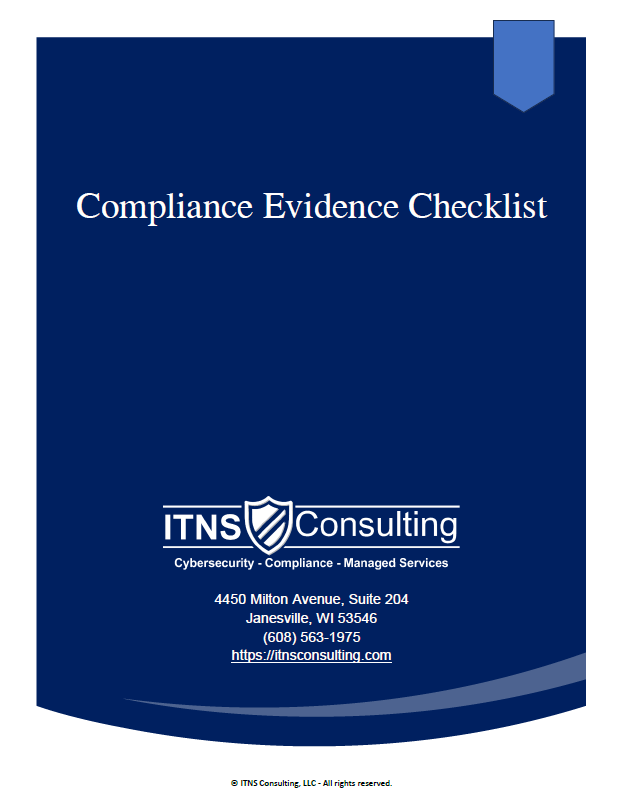
📂 Compliance Evidence Checklist — Free Download
Know What Proof You Need. Avoid Gaps. Stay Audit Ready.
It helps you organize what auditors and insurers expect, strengthen governance, reduce operational risk, and prepare for assessments, renewals, or vendor reviews.
Perfect for:
✔️ Businesses preparing for cyber‑insurance renewal
✔️ Organizations working toward NIST CSF alignment
✔️ Teams with limited internal IT/compliance resources
✔️ Providers handling sensitive or regulated data
✔️ Anyone who wants predictable, repeatable IT governance