Data loss disasters come in many forms, ranging from full-scale natural calamities to cyberattacks, and even simple human errors. Disasters can bring businesses to a grinding halt. Apart from financial and reputational damage, failing to protect valuable data can also result in expensive lawsuits.
That’s why businesses, regardless of size, must have a backup and disaster recovery (BCDR) plan. By implementing a foolproof BCDR, you can quickly get your business back up and running should disaster strike. It will also help you comply with governmental and industry regulatory frameworks.
In this post, we’ll break down the different types of data loss disasters and outline the key BCDR components that can help you make it through a disruptive event with flying colors.
The Many Forms Data Loss Can Take
Let’s analyze the various types of data loss disasters that can hurt your business:
Natural disasters
This covers everything from storms, hurricanes, floods, fires, tsunamis, and volcano eruptions. In most cases, you can expect infrastructural damages, power failure, and mechanical failures, which could then lead to data loss.
Hardware and software failure
Software and hardware failure can cause data loss if you don’t have BCDR measures in place. These disruptions could be due to bugs, glitches, configuration errors, programmatic errors, component failures, or simply because the device is at its end of life, or the software is outdated.
Unforeseen circumstances
Data loss can happen due to random, unexpected scenarios. For instance, a portable hard disk held by an employee could get stolen, your server room may have a water leak because of a plumbing issue, or there could even be a pest infestation in one of your data centers.
Human factor
Human errors are a leading cause of data loss incidents. These errors range from accidental file deletions, overwriting of existing files and naming convention errors, to forgetting to save or back up data, or spilling liquid on a storage device.
Cyberthreats
Your business may fall prey to malware, ransomware, and virus attacks, which could leave your data and backups corrupt and irrecoverable. Additionally, data loss could be caused by malicious insiders with unauthorized access, which often goes under the radar.
Key Components of BCDR
Here are a few crucial things to keep in mind as you build a robust BCDR strategy:
Risk assessment
Identify potential risks and threats that would impact business operations. Measure and quantify the risks to tackle them.
Business impact analysis (BIA)
Assess the potential consequences of a disruptive event on critical business functions and prioritize them in the recovery plan.
Continuity planning
Implement procedures to resume critical business operations during disruption, with minimal downtime.
Disaster recovery planning
Plan a well-defined business resumption plan to recover critical IT functions and data following a disruptive incident.
Testing and maintenance
Periodically test your disaster recovery and backup plans to ensure they can be recovered in a disaster. If they fail, you can work on the enhancement.
Data Loss Can Happen in More Ways Than Most Businesses Realize
Data loss is not limited to cyberattacks or ransomware. Hardware failures, accidental deletions, software corruption, natural disasters, human error, and vendor outages can all disrupt operations and threaten critical business information.
The organizations that recover most successfully are those that prepare before an incident occurs. Reliable backups, documented recovery procedures, regular testing, and business continuity planning help reduce downtime and improve resilience when unexpected events arise.
A backup strategy is not just about protecting files. It is about protecting productivity, customer trust, operational continuity, and the future of your business.
The question is not whether a disruption will occur. The question is whether your organization is prepared to recover when it does.
Could Your Business Recover from a Data Loss Event?
Many organizations assume their backups are working until they are forced to rely on them. If you’re unsure whether your backup strategy, disaster recovery plan, and business continuity processes are sufficient, schedule a free consultation with ITNS Consulting. We’ll help you evaluate your current approach, identify potential gaps, and develop a practical strategy for improving recovery readiness.
Is Your Business Ready to Recover from Data Loss?
Data loss can result from cyberattacks, hardware failures, human error, and many other unexpected events. The ability to recover quickly often determines whether an incident becomes a temporary inconvenience or a major business disruption.
Download our Backup & Disaster Recovery Preparedness Checklist to evaluate your current backup strategy, identify potential weaknesses, and strengthen your organization’s ability to recover from data loss and other unexpected disruptions.
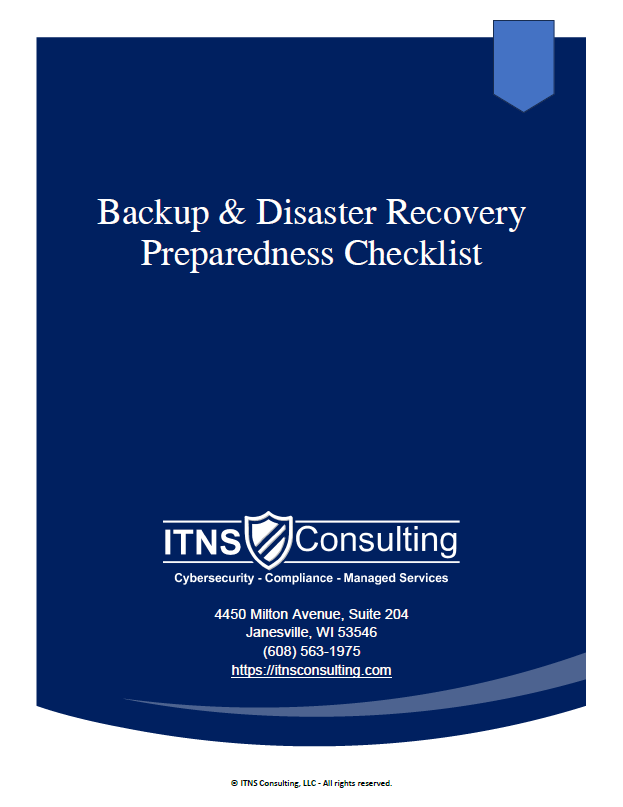
💾 Backup & Disaster Recovery Preparedness Checklist — Free Download
Be Ready for the Inevitable: Outages, Mistakes, Cyberattacks & Hardware Failures
This checklist helps leaders verify the reliability of their backup & recovery posture by highlighting the items that matter most: integrity, separation, testing, documentation, and clear expectations.
Perfect for:
✔️ Small and midsize businesses
✔️ Organizations preparing for cyber‑insurance renewal
✔️ Teams evaluating current IT providers
✔️ Companies with compliance or uptime requirements
✔️ Businesses that cannot afford downtime or data loss