If you think that your cyber insurance claim will be cleared with no questions asked, think again. While reviewing your claim, your cyber insurance provider will assess whether you took “due care” to protect your business from being compromised by a cyber attack. If not you may get notified “Cyber Insurance Claim Denied”.
While having a cyber liability insurance policy is non-negotiable today, you cannot be fully assured that your insurer will cover any of the costs you incur following a security breach.
Hidden in the fine print of your cyber insurance policy document are certain terms and conditions set by the insurer that you must be compliant with. That’s why it is important for you to assess whether you are compliant with the terms of your cyber insurance policy and ensure that any risks that could lead to non-compliance are remediated.
Let’s take a look at some of the common reasons why cyber insurers deny claims, what impact claim denials can have and how the right support can help you ensure your cyber insurance claim isn’t denied due to non-compliance.
Top 6 Reasons Why Your Cyber Insurer May Deny Your Claim
Besides their efforts to minimize payouts and boost the loss ratio (the ratio of premiums to payouts), cyber liability insurance companies look at various other aspects to deny a payout or payout only to a certain extent. Here are six of the most common reasons why your cyber insurer may either deny your claim completely or a sizeable portion of it.
1. Policy Exclusions
Policy exclusions can be easily considered the biggest reason for claim denials. Applying for a claim for a security incident that falls in the list of exclusions that are often mentioned in the fine print of the policy document could prove to be a futile exercise.
2. Poor Prevention Practices
By not having enough prevention practices in place, you could be handing the insurance company an easy reason to deny your claim. Your insurance policy lists data security practices that you must implement in your business’ network.
3. Failure to Document Preventative Measures
Your insurer will want to see tangible evidence, in the form of documentation, regarding the preventative measures you have undertaken to ward off cyber threats. To avoid any hassles, you need to have thorough, accurate and updated documentation at all times.
4. When a Third-Party Stakeholder Is at Fault
Your network’s security isn’t just your responsibility. It’s the responsibility of your third-party stakeholders as well. A security lapse in a third-party vendor’s network could result in the claim being denied by the insurer. Even if the claim isn’t denied, it’s highly likely that the insurer will scrutinize the matter in depth, which could make it a long, drawn-out process.
5. Accidental Errors and Omissions
Accidental errors and omissions in the documentation you share with the insurer could prove detrimental to the approval of your claim. The documented evidence should encompass everything you have done to abide by the terms put forth by the insurer.
6. When Coverage Doesn’t Extend Beyond the Interruption Timeframe
Cyber liability insurance plans vary, so you must pay close attention to coverage timeframes. This could be the difference between getting all your losses being covered versus just a small percentage of them.
The Possible Impact of a Claim Denial
A claim denial can derail a business’ strategy to recover the costs incurred following a security incident. Here are two instances when businesses were denied payouts:
The Peculiar Case of the NotPetya Attacks
Researchers at the Cyentia Institute reviewed the 100 largest cybersecurity incidents over the last five years, which accounted for US$18 billion in losses, and discovered that the NotPetya ransomware accounted for 20% of losses.
Despite that, the pharmaceutical giant Merck and multinational food company Mondelez International are still in the process of claiming US $1.3 billion and US $100 million respectively through high-profile lawsuits.
In both proceedings, the insurers cited the “war and terrorism” exclusion to deny the claims since in October 2020 the U.S. government indicted six Russian military personnel for the attacks.
When a Canadian Not-For-Profit Was Denied a Payout
In a case settled in May 2021, Family and Children’s Services of Lanark, Leeds and Grenville (FCSLLG), a Canadian not-for-profit organization, failed to seek CAD$75 million in damages.
The security incident involved an unidentified hacker who stole confidential reports and leaked them on two Facebook pages. FCSLLG initiated a third-party claim against Laridae, a company it had hired to revise its website.
Despite holding two policies with the Co-operators at the time of the hack, the Co-operators denied coverage under both policies based on data exclusions. The policies excluded any loss “arising out of the distribution or display of data by means of an internet website.”
These incidents should serve as a glaring reminder for your business to completely understand where threats are most likely to emerge from and to ensure that potential losses are included in your cyber insurance policy.
While certain businesses may be able to continue functioning as usual due to their financial prowess, you must ask yourself if your business can survive a major financial setback.
Navigating Compliance for Cyber Liability Insurance
While it may seem overwhelming at the outset, complying with your cyber liability insurance policy’s terms isn’t daunting when you have the right support.
By leveraging our compliance process automation platform, we can help you with:
- Understanding the contracts in detail so that you are fully aware of what your policy covers and what it does not cover.
- Regular automated compliance assessment that will hand you a thorough and accurate analysis of your business’ compliance with the policy’s terms and areas that need remediation.
- Remediation services to ensure all the compliance risks are remediated the right way and at the right time.
- Compliance-specific documentation that’s free of human error, fine-grained and policy-specific to ensure your business can produce evidence of due care.
- Purchasing a cyber insurance policy that offers the right type of coverage at the right price.
ITNS Consulting can help your organization comply with, or acquire, a viable cyber liability insurance policy that’s trusted by others in your industry.
Cyber Insurance Only Works When Requirements Are Met
Many organizations purchase cyber liability insurance believing they are fully protected if a cyber incident occurs. However, coverage is often tied to specific security, compliance, and risk management requirements. If those obligations are not met, organizations may face denied claims, reduced coverage, or unexpected disputes during the recovery process.
The most successful organizations treat cyber insurance as part of a broader cybersecurity and risk management strategy. Strong authentication controls, documented policies, employee awareness training, incident response planning, vendor oversight, and ongoing risk assessments all help support both cybersecurity resilience and insurance readiness.
The goal is not simply purchasing a policy. It is ensuring your organization has the controls, documentation, and processes necessary to support coverage requirements and improve the likelihood of a successful claim.
The best time to identify potential gaps is before a cyber incident occurs, not after a claim has been submitted.
Would Your Cyber Insurance Claim Be Approved Today?
Many organizations are surprised to learn how much cybersecurity documentation, evidence, and control validation insurers expect before approving claims. If you’re unsure whether your current security posture aligns with your policy requirements, schedule a free consultation with ITNS Consulting.
We’ll help evaluate your cybersecurity controls, identify potential compliance gaps, assess insurance readiness, and develop a practical roadmap for strengthening both your security posture and insurability.
Are You Ready for Your Next Cyber Insurance Review?
Cyber insurers increasingly require businesses to demonstrate strong cybersecurity controls, documented procedures, employee training, and ongoing risk management practices before issuing or renewing coverage.
Download our Cyber Insurance Application Readiness Checklist to evaluate your current cybersecurity posture, identify potential gaps, and better prepare for cyber insurance applications, renewals, underwriting reviews, and future claims.
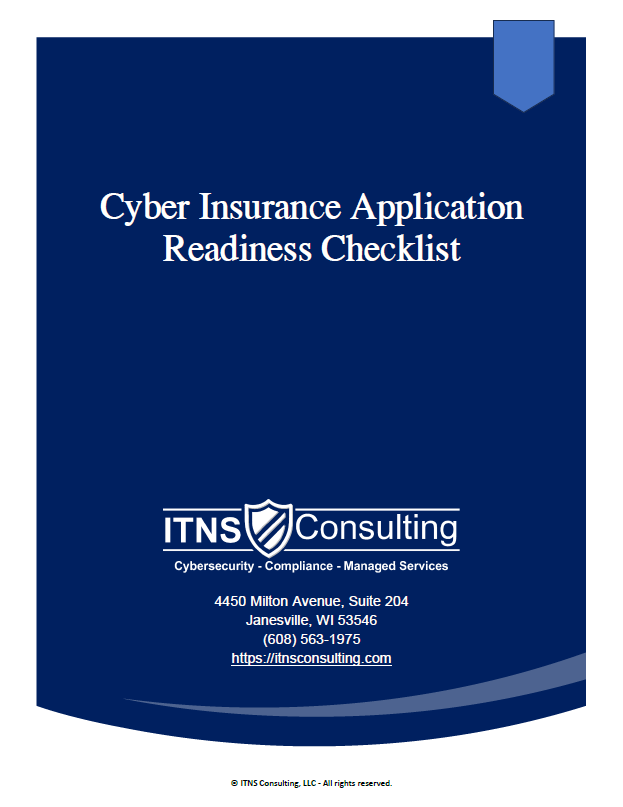
🛡️ Cyber Insurance Application Readiness Checklist — Free Download
Prepare with Confidence. Avoid Surprises. Strengthen Your Application.
This checklist breaks down the critical factors cyber insurers evaluate, helping you identify missing controls, gather the required evidence, and avoid application misstatements that could lead to denied claims.
It also strengthens your cybersecurity and governance posture, improving your chances of approval and more favorable premium terms.
Perfect for:
✔️ Small and mid-size businesses
✔️ Organizations renewing cyber policies
✔️ Teams preparing for their first cyber insurance application
✔️ Businesses evaluating internal or outsourced IT performance
✔️Companies wanting defensible, well‑documented security controls