As the world becomes more digital, so do the risks of conducting business online. Cyber incidents can happen to any business, regardless of size or industry, and can have serious consequences.
Common Types of Cyber Incidents:
Phishing
Phishing is an online scam in which criminals send emails or instant messages falsely claiming to be from a legitimate organization. These messages typically contain links to bogus websites designed to steal your personal information such as your login credentials or credit card number. Phishing attacks can be challenging to detect because scammers use familiar logos and language to dupe their victims.
Denial-of-Service
A denial-of-service attack makes a computer or other service inaccessible to users. These attacks are carried out by flooding the victim’s computers or network with requests, rendering it unable to respond to legitimate traffic or causing it to crash. Such attacks can be excessively disruptive and can result in significant financial losses.
Ransomware
A ransomware attack is a cyber attack through which hackers encrypt a victim’s data and demand a ransom to decrypt it. Encryption is the process of transforming readable data into an unreadable format. This is done using a key, which is a piece of information that controls the transformation. Only the same key can convert the unreadable format to readable data or decrypt it.
These attacks can be incredibly detrimental to individuals and organizations since they frequently lead to loss of data or money.
SQL Injections
An SQL injection is a form of attack cyber criminals use to execute malicious SQL code in a database. Simply speaking, SQL code is a language to communicate to computers. You can use it to tell the computer what you want it to do, like find some information or create a table, for example. Cyber criminals use this code to change, steal or delete data.
SQL injection attacks pose a serious risk to any website that relies on a database because they can cause irreversible damage.
Malware
Malware is software that is intended to harm computer systems. It can take the form of viruses, Trojans or spyware. Malware can be used to steal personal information, corrupt files and even disable systems.
Nothing could be further from the truth if you believe cyber criminals only target large corporations. According to a recent report, 43% of all cyber attacks target small businesses.
Real Cyber Incidents Experienced by Small Businesses
Although the media usually under reports attacks on small businesses and focuses on data breaches that affect large corporations, here are two instances of incidents that severely impacted small businesses:
– When the bookkeeper of a boutique hotel began receiving insufficient fund notifications for regularly recurring bills, the chief executive officer (CEO) realized their company had been the victim of wire fraud.
A thorough examination of the accounting records revealed a severe issue. A few weeks prior, the CEO had clicked on a link in an email that they mistook for one from the Internal Revenue Service (IRS). It wasn’t the case. Cyber criminals obtained the CEO’s login information, giving them access to sensitive business and personal information.
This attack had a significant impact. The company lost $1 million to a Chinese account and the money was never recovered.
– The CEO of a government contracting firm realized that access to their business data, including their military client database, was being sold in a dark web auction. The CEO soon noticed that the data was outdated and had no connection to their government agency clients.
How did this data leak happen? The company discovered that a senior employee had downloaded a malicious email attachment thinking it was from a trusted source.
The breach had a significant operational and financial impact, costing more than $1 million. The company’s operations were disrupted for several days since new security software licenses and a new server had to be installed.
Preparation Determines How Well You Recover
Cyber incidents are no longer a matter of if, but when. While strong cybersecurity controls help reduce risk, no organization can eliminate every threat. The businesses that recover most effectively are often the ones that prepare before an incident occurs.
Preparation goes beyond technology. It requires clearly defined responsibilities, documented response procedures, communication plans, recovery processes, and regular testing. When employees know what to do and leadership has a structured response plan, organizations can minimize disruption, reduce uncertainty, and recover more quickly.
An effective incident response strategy helps protect more than systems and data. It helps preserve customer trust, maintain operational continuity, and reduce the long-term impact of unexpected events.
The best time to build an incident response plan is before you need it.
Does Your Organization Know How It Would Respond to a Cyber Incident?
Many businesses invest in cybersecurity tools but never develop a documented plan for what happens when those defenses are tested. If you’re unsure whether your organization is prepared to respond to a cyber incident, schedule a free consultation with ITNS Consulting.
We’ll help you evaluate your current readiness, identify potential gaps, and develop a practical incident response strategy that supports your business, your employees, and your customers when it matters most.
Would Your Team Know What to Do During a Cyber Incident?
A well-documented response plan can dramatically reduce confusion, downtime, and business disruption during a cybersecurity event.
Download our Incident Response Plan Template to establish clear roles, responsibilities, communication procedures, and recovery actions that help your organization respond effectively when an incident occurs.
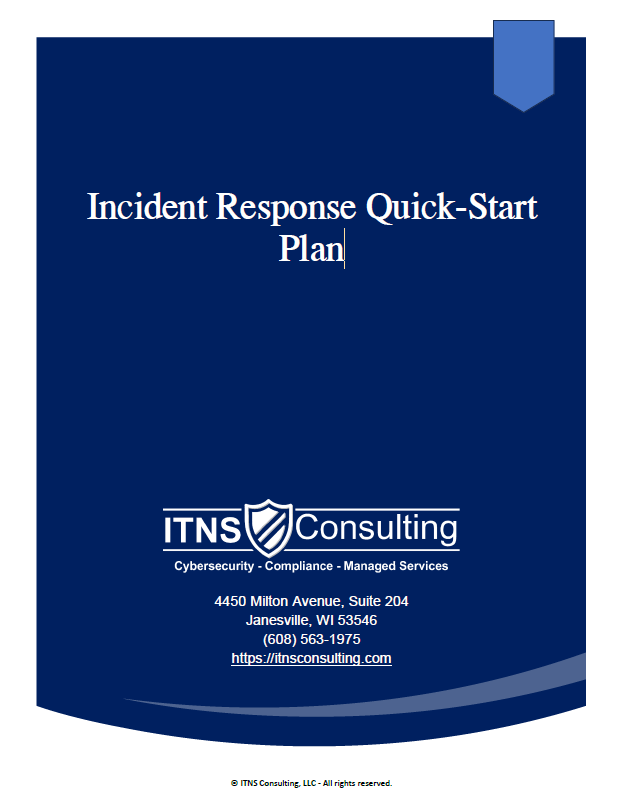
🚨 Incident Response Quick Start Plan — Free Download
React Fast. Minimize Damage. Restore Operations With Confidence.
This plan breaks incident response into clear, actionable steps that help you contain threats, protect critical systems and data, preserve evidence, and communicate confidently.
It also guides secure system recovery and documentation of findings to reduce risk and prevent similar incidents from happening again.
Perfect for:
✔️ Small and mid-size businesses without a formal IR plan
✔️ Teams evaluating their current provider’s response capabilities
✔️ Organizations preparing for cyber‑insurance renewal
✔️ Leaders wanting basic readiness before adopting full IR playbooks
✔️ Anyone who wants to reduce panic and confusion during an incident