

In today’s digital environment, cyber threats aren’t limited to major enterprises. A growing number of attackers now target small businesses because limited budgets, small teams, and minimal technical resources often translate into a lack of cybersecurity, making these organizations easier to penetrate.
For small business owners who already juggle sales, operations, HR, and customer service, cybersecurity often gets pushed aside. Unfortunately, this lack of preparation leaves the business exposed and provides threat actors with exactly what they’re looking for: a clear, unguarded entry point.
Addressing cybersecurity isn’t just an IT task, it is essential to business continuity, financial stability, and long-term survival.
How a Lack of Cybersecurity Affects Small Businesses
Because small businesses operate with leaner teams and tighter margins, the consequences of a cyber incident are often more severe than they would be for larger organizations. Here’s how a lack of cybersecurity preparation typically impacts smaller operations:
- Sensitive Customer Data Becomes Easy to Steal
Small businesses accumulate critical information such as:
- customer records
- billing details
- confidential documents
- payment card information
When there’s a lack of cybersecurity, this data becomes extremely vulnerable.
Example:
A small landscaping company keeps customer payment data in an unencrypted spreadsheet. A single malware infection could expose every card number leading to customer distrust, refund demands, and potential lawsuits.
Even low-tech operations often overlook how valuable their data is to cybercriminals. Once stolen, it can take years to rebuild customer confidence.
- Downtime Hits a Small Team Hard
Large companies can often continue running during an attack because they have backup systems, bigger teams, and internal IT support. Small businesses normally don’t have that luxury.
A lack of cybersecurity preparation can shut down essential tasks such as:
- scheduling
- inventory management
- order processing
- email communication
- point-of-sale transactions
Real-world example:
A boutique bakery with five employees is struck by ransomware. With no backups, the POS system won’t load, staff schedules disappear, and accounting software is locked. The business can’t process orders or confirm catering appointments leading to an entire day (or more) with zero revenue.
For a small business, downtime doesn’t just inconvenience customers, it can cripple operations.
- The Financial Impact Can Be Overwhelming
Cyber incidents are expensive, and small businesses have limited cash reserves. When a breach occurs, costs rapidly accumulate, including:
- emergency IT services
- equipment replacement
- revenue losses
- legal expenses
- regulatory penalties
- customer compensation
Small-business example:
A local insurance agency hit by a phishing attack must hire forensic analysts, notify all affected clients, purchase credit monitoring subscriptions, and invest in stronger security tools. Even a modest breach can result in tens of thousands of dollars in expenses far beyond what many small businesses can absorb.
A lack of cybersecurity often turns one cyber incident into a full-blown financial crisis.
- Legal and Regulatory Risks Increase
Many small business owners mistakenly assume compliance requirements only apply to large corporations. But any company that stores or transmits customer information may face legal consequences if a breach occurs due to a lack of cybersecurity.
You may be responsible for complying with:
- state privacy laws
- industry-specific regulations (HIPAA, PCI-DSS, etc.)
- contractual obligations
A breach caused by poor preparation could trigger fines, lawsuits, and mandatory reporting requirements, adding more stress and cost to an already difficult situation.
- Long-Term Reputation Damage Can Be Devastating
Small businesses depend heavily on trust, referrals, and community reputation. Larger brands may bounce back from breaches with the help of PR firms and marketing teams, but small businesses often struggle to regain credibility.
Example:
A neighborhood tax preparer experiences a data leak shortly before tax season. Even after correcting the issue, many clients may choose to go elsewhere and warn friends and family to do the same.
A lack of cybersecurity not only causes immediate disruption but can also impact customer perception for years.
Why Preparation Is Essential for Small Teams
Most small businesses don’t have in-house cybersecurity personnel, so preparation becomes the most cost-effective way to reduce risk. Even basic steps can significantly strengthen security.
- Incident Response Plans Prevent Panic and Speed Up Recovery
A clear incident response plan outlines:
- who to contact
- how to isolate affected devices
- which systems must be restored first
- what to tell customers and employees
Small-business example:
A consulting agency writes a simple one-page response plan for phishing incidents. When an employee clicks a suspicious link, the team follows the checklist and prevents the attack from spreading.
Even a brief plan is better than no plan, especially when every minute counts.
- Employee Training Eliminates Many Avoidable Threats
Human error is responsible for most cyber incidents. With a small team, one mistake can impact the entire business.
Training should include:
- identifying phishing emails
- using strong passwords
- avoiding suspicious downloads
- understanding social engineering attempts
Example:
A real estate office provides brief monthly cybersecurity refreshers. When an agent spots a fraudulent wire-transfer request, they avoid what could have been a six-figure scam.
Consistency, not complexity is the key to effective training.
- Regular Updates and Backups Keep the Business Resilient
Attackers often exploit outdated systems. Small businesses frequently postpone updates due to workflow interruptions, but each delay increases risk.
Backups (especially automated cloud backups) are essential for fast recovery.
Practical example:
A small accounting firm performs daily cloud backups. When a malware attack corrupts local files, they restore all client data within hours.
Simple actions like updating software and backing up data can prevent the crushing consequences of a lack of cybersecurity.
Cybersecurity Is a Business Necessity, Not a Technical Luxury
A lack of cybersecurity is not simply a technology problem. It is a business risk that can affect finances, operations, customer relationships, and long-term growth. For small businesses, the impact of a cyber incident can be especially severe because resources for recovery are often limited.
The good news is that meaningful improvements do not always require large budgets or complex solutions. Building an incident response plan, training employees, applying security updates, implementing strong authentication, and maintaining reliable backups can significantly reduce risk and improve resilience.
Cybersecurity is ultimately about preparation. Organizations that invest in practical safeguards today are far better positioned to withstand the challenges of tomorrow and continue serving their customers with confidence.
Is Your Business Prepared for Today’s Cyber Threats?
Many small businesses assume they are too small to be targeted until an incident proves otherwise. If you’re unsure whether your organization has the safeguards needed to protect its data, systems, and reputation, schedule a free consultation with ITNS Consulting. We’ll help you identify potential risks and develop a practical cybersecurity strategy tailored to your business.
How Resilient Is Your Business?
Cyber threats, system outages, and operational disruptions can happen to any organization. Download our Small Business Cyber Resilience Checklist to evaluate your preparedness, identify potential weaknesses, and strengthen your ability to respond to and recover from cybersecurity incidents.
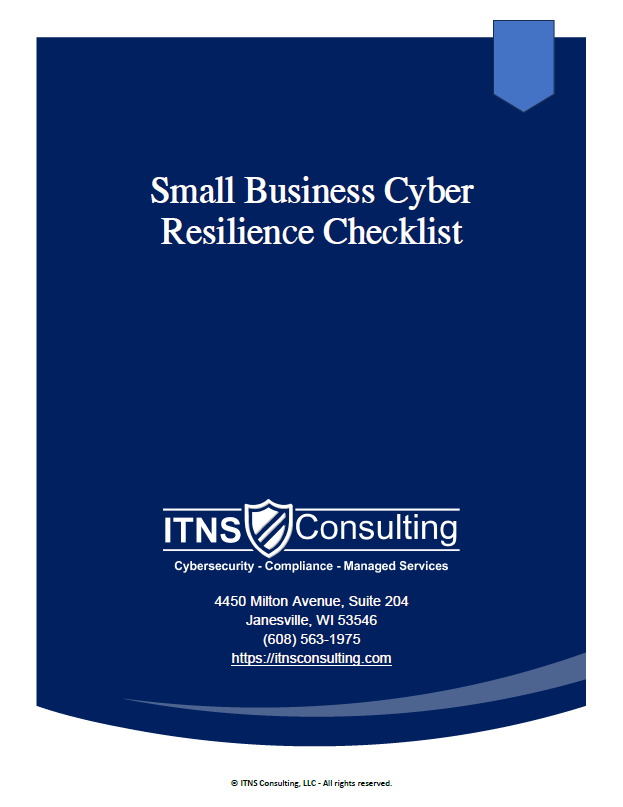
🧩 Small Business Cyber Resilience Checklist — Free Download
Find Your Gaps. Fortify Your Operations. Bounce Back Faster.
A concise, action‑oriented format that shows what to check, what to fix, and what to document so you can strengthen operations, meet insurance/client expectations, and keep teams productive.
Perfect for:
✔️ Owners and GMs without dedicated IT staff
✔️ Leaders evaluating current IT providers or processes
✔️ Teams planning improvements this quarter
✔️ Companies preparing for cyber insurance renewal or vendor due diligence