Phishing attacks, ransomware, malware, or any other security threat are referred to as an “incident” in the IT world. Imagine it’s the end of a long workday and you’re ready to head home for the evening. However, just as you’re about to leave, you find out your email credentials have been hacked and critical data has been stolen from your business. Its time to implement your businesses Incident Response Plan. You have one, right?
An Incident Response Plan is a plan in place to respond quickly and effectively to minimize the impact on your business, and steer it to a more favorable outcome. Remember, the longer it takes to address a cyber incident, the more harm cybercriminals can do to your business, such as severe data loss and damage to your bottom line and reputation.
Cyber Incident Response 101
According to the National Institute of Standards and Technology (NIST), incident response has five phases:
Identify
There are numerous security risks to be aware of in order to develop an effective incident response plan. This includes threats to your technology systems, data and operations, among other things. Understanding these risks allows you to be better prepared to respond to incidents and reduce their impact.
To identify risks, you can start by looking at system logs, examining vulnerable files or tracking suspicious employee activity.
Protect
It’s critical to create and implement appropriate safeguards to protect your business. Safeguards include security measures to guard against threats and steps to ensure the continuity of essential services in the event of an incident.
To protect your business against cyberthreats, you can use backups, implement security controls such as firewalls, and train employees on security best practices.
Detect
Quickly detecting irregularities, such as unusual network activity or someone attempting to access sensitive data, is essential to limit the damage and get your systems back up and running faster.
Deploying techniques such as intrusion detection systems (ISDs) is an effective way to tackle irregularities.
Respond
You need to have a plan in place to respond to detected cyber incidents. This plan should include strategies for breach containment, investigation and resolution.
A few things you can do to respond to an incident are isolating affected systems and cutting off access to every impacted system.
Recover
Following an incident, you must have a plan in place to resume normal business operations as soon as possible to minimize disruption.
These steps can be part of your recovery plan:
- Restoring systems that have been affected by the attack
- Implementing security controls to prevent the incident from happening again
- Investigating the root cause of the event
- Taking legal action against perpetrators
Keep in mind that a well-crafted incident response plan will help you resolve a breach, minimize the damage caused, and restore normal operations quickly and effectively. It’s critical to ensure that all staff are aware of the incident response plan and know their roles and responsibilities in the event of a breach.
An incident response plan should be reviewed and updated regularly to ensure that it remains relevant and effective. Cyber incidents can occur at any time, so it’s crucial to be prepared.
Incident Response Planning Is an Essential Business Capability
No organization can completely eliminate the risk of cyber incidents. However, every organization can improve how effectively it responds when an event occurs. The difference between a minor disruption and a major business crisis often comes down to preparation, communication, and having a documented response process in place before an incident happens.
An effective incident response program helps organizations reduce confusion, accelerate recovery, protect critical data, and minimize operational disruption. By establishing clear responsibilities, communication procedures, escalation paths, and recovery processes, businesses can respond with confidence rather than uncertainty.
Cyber resilience is not defined by whether an incident occurs. It is defined by how well your organization is prepared to detect, respond to, recover from, and learn from that incident.
The best time to develop an incident response plan is before you need one.
Does Your Business Have a Plan for the Next Cyber Incident?
Many organizations invest in cybersecurity tools but never document how employees, leadership, and technology teams should respond when an incident occurs. If you’re unsure whether your organization is prepared to respond effectively to a cyber event, schedule a free consultation with ITNS Consulting.
We’ll help you evaluate your current readiness, identify potential gaps, and develop a practical incident response strategy that supports your business continuity, cybersecurity, and recovery objectives.
Would Your Team Know What to Do During a Cyber Incident?
A documented incident response plan can significantly reduce confusion, downtime, and business disruption when a cybersecurity event occurs.
Download our Incident Response Plan Template to establish clear roles, responsibilities, communication procedures, escalation paths, and recovery actions that help your organization respond effectively when an incident occurs.
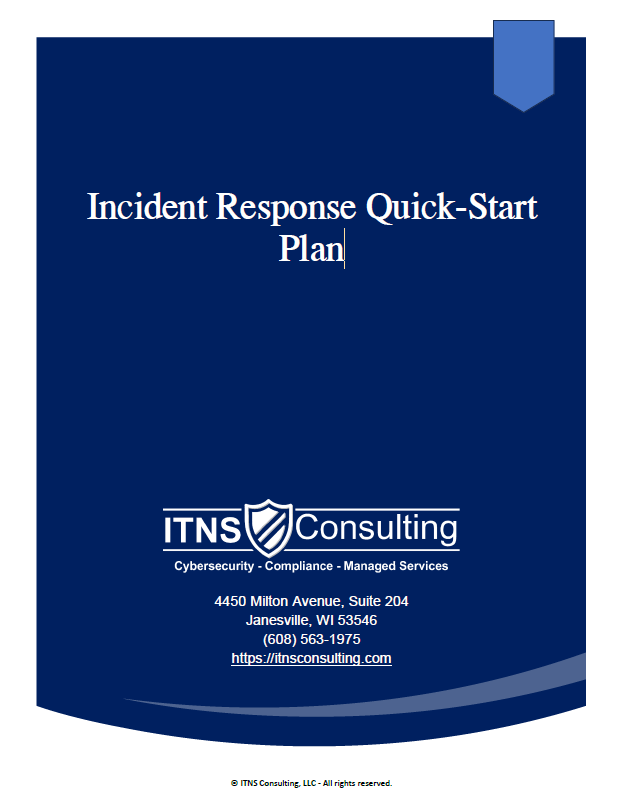
🚨 Incident Response Quick Start Plan — Free Download
React Fast. Minimize Damage. Restore Operations With Confidence.
This plan breaks incident response into clear, actionable steps that help you contain threats, protect critical systems and data, preserve evidence, and communicate confidently.
It also guides secure system recovery and documentation of findings to reduce risk and prevent similar incidents from happening again.
Perfect for:
✔️ Small and mid-size businesses without a formal IR plan
✔️ Teams evaluating their current provider’s response capabilities
✔️ Organizations preparing for cyber‑insurance renewal
✔️ Leaders wanting basic readiness before adopting full IR playbooks
✔️ Anyone who wants to reduce panic and confusion during an incident